
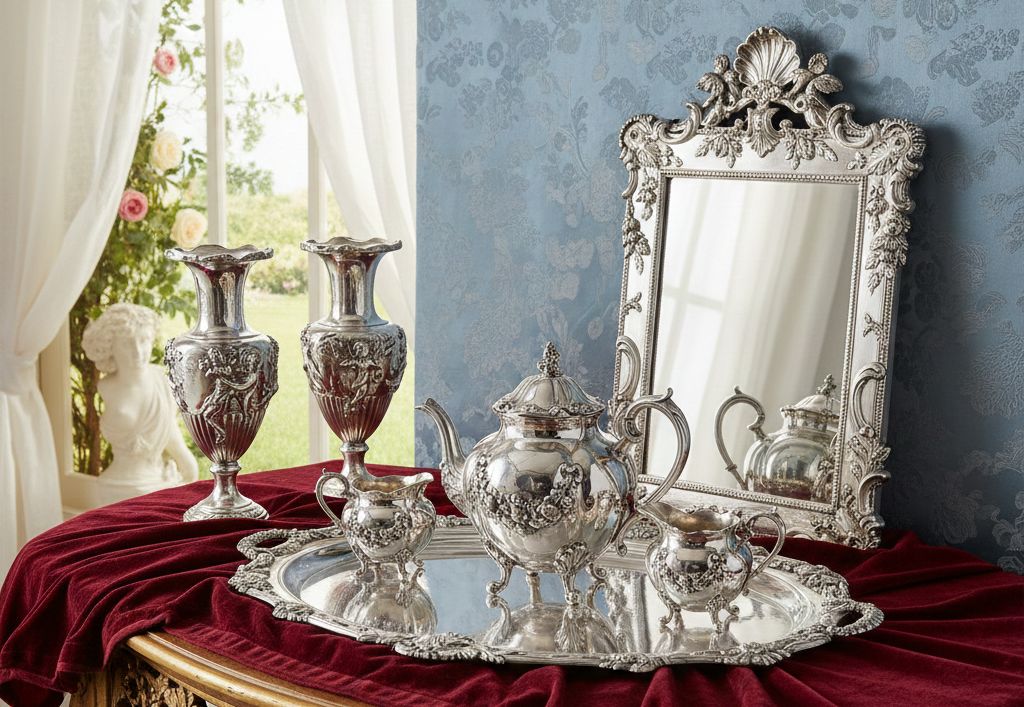
Rococo Silver: A Symphony of Fluidity and Light
For decades, European court life was defined by the solemn grandeur of the Baroque, where every object, from a throne to a tankard, spoke of absolute power and rigid symmetry. Then, like a sudden burst of laughter echoing through the echoing halls of Versailles, the spirit of the Rococo arrived. It swept away the heavy drapery and moral weight of its predecessor, replacing it with an intoxicating blend of lightness, playfulness, and asymmetrical grace.
Rococo silver design is one of the most expressive chapters in the story of antique decorative arts. It is bold, theatrical, playful, and full of life.
Picture the gleam of 18th-century French silver shaped into swirling scrolls and seashells. That was the spirit of Rococo.
Before collectors and historians named it, Rococo was simply the style of a world hungry for fantasy and elegance. Today, it stands as one of the most collectible and recognisable decorative styles, especially in the world of antique silver.
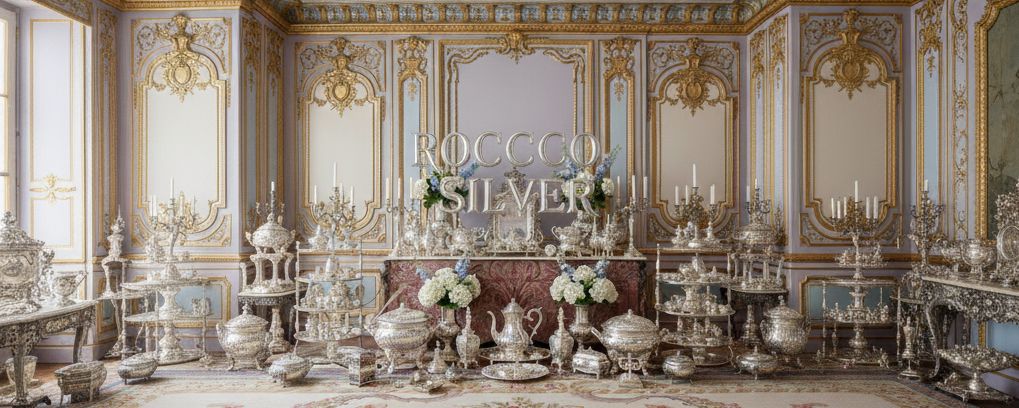
What Is Rococo?
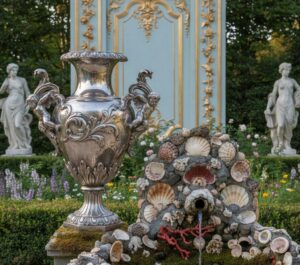
Rococo began in France around the 1730s as a reaction to the heavy seriousness of the Baroque period.
The word “Rococo” itself is derived from the French “rocaille”, which translates as “rock work”. Rocaille was a method of ornamentation commonly used during the Renaissance, which used pebbles, seashells and cement applied on surfaces such as mirrors or porcelain to decorate gardens and fountains.
After being pioneered by French design, Rococo saw its popularity spread throughout Europe in the early 1700s. Bavaria, Austria, Germany and Russia all embraced the frivolous style along with its playful and witty themes.
Also Read: The Modern Rococo Comeback
Characteristics of Rococo Silver
The Rococo silver design is instantly recognisable. The traits below define the style and shape the best work of 18th-century silversmiths.
- Curved, Asymmetrical Forms
Rococo avoided straight lines. Silver pieces twist, sweep, and ripple. Handles look like living vines. Borders curl like waves.
- Shells and Scrolls
The scallop shell is the king of Rococo motifs. Scrollwork mimics waves, leaves, clouds, and unfurling plants. These were not flat decorations but sculpted into deep relief that cast dramatic shadows
- Natural Elements
Flowers, fruit, and foliage are everywhere in antique silver Rococo patterns. These motifs soften the metal and give it a sense of life.
The acanthus leaf motif, or rather a heavily stylised version of it, was also a signature motif.
- Playful Scenes
Some 18th-century French silver includes engraved or sculpted scenes of court life, cherubs, or pastoral imagery. These were meant to charm rather than impress.
- Rich Ornamentation
Rococo silver rarely holds back. Even practical items like teapots or serving trays feel theatrical. Every surface becomes a canvas.
Also Read: The Complete Guide To Antique Silver Investments
The Silversmith’s Canvas: Influence and Spread
The influence of Rococo on 18th-century French silver began with the great Parisian silversmiths who catered directly to the royal court and the elite aristocracy.
Rococo in England was considered the “French taste.” Rococo silversmiths enthusiastically embraced the style, as it was a stark contrast to the more elegant, yet plain, style of the Baroque period. Rococo silver is characterised by abundant swirling patterns that signify the flow of water, as well as floral designs and shells.
Key Techniques
Rococo silversmiths relied on a range of decorative techniques to create the lively surfaces and deep sculptural detail that define the style.
- Embossing
Embossing creates a pattern raised in relief. The design rises above the surface, catching the light and giving the piece a sense of volume and motion.
- Repousse
Repoussé is a more advanced form of embossing.
- Chasing
Chasing works from the front and refines the details created by repousse.
- Engraving
Engraving is a line decoration cut directly into the metal from the front. It adds fine details.
- Chinoiserie Elements
Chinoiserie is decoration inspired by Chinese art and design. During the Rococo period, this became a fashionable variation.
Key Rococo Silversmiths
- Juste-Aurele Meissonnier (1695-1750): A silversmith from Turin, Meissonnier embraced the flamboyance of the Rococo style, crafting items which featured flowing lines.
- Thomas Germain and his son François: Parisian designers at the heart of the cultural movement, both commissioned by the King of Portugal.
- Paul de Lamerie (1688- 1751): Perhaps the most well-known Rococo silversmith today, this period cannot be discussed without recalling his work in the combination of elaborate French design/ornamentation with the highest quality British silver.
Top 5 Collectible Rococo Silver Pieces
While many forms exist, certain silver collectibles stand out as prime targets for collectors today. Auction results show steady interest in these categories, and platforms such as Giftex Online Auction often feature them in curated sales.
- Large Serving Trays and Salvers
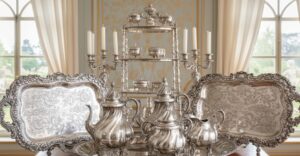
These are centrepieces of Rococo silver design. Their broad surfaces become showcases for engraved scrolls, shells, and floral patterns. The edges are often scalloped or cast with sweeping curves. Large trays from Parisian workshops or English silversmiths like Paul de Lamerie are among the most valuable.
- Tea and Coffee Sets
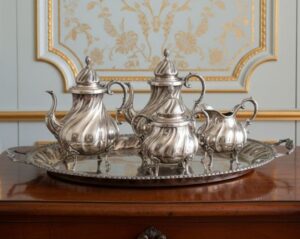
The rise of tea culture in the 18th century made these sets essential household luxuries. Rococo sets feature exuberant spouts, sculpted handles, and bulbous bodies full of motion. Lids often bloom with fruit or flower finials. Complete sets with matching trays are highly collectible.
- Candlesticks and Candelabras
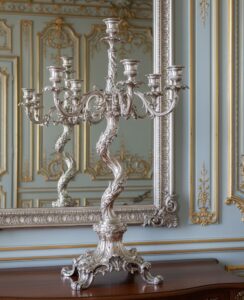
Few pieces capture the drama of Rococo better than tall, twisting candelabras. Their stems curve like vines, and their bases often rest on shell-like feet. Multi-branch candelabras are especially desirable because they highlight symmetry and asymmetry at once. Candlesticks from French makers like Odiot or German courts such as Augsburg are top-tier.
- Speciality Serving Pieces
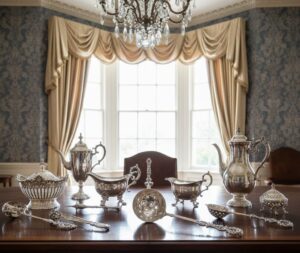
Rococo turned everyday dining into a theatrical experience. Speciality pieces include sauceboats, fish servers, sugar baskets, chocolate pots, snuffers, and punch strainers. Items designed for specific purposes, such as asparagus servers, punch ladles, or large berry spoons with gilded bowls, are popular among collectors.
- Decorative Boxes and Trinkets
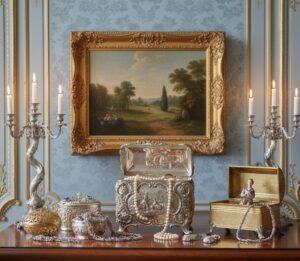
Snuff boxes, vinaigrettes, and small lidded containers were essential accessories of the time. These small objects capture the intimacy of the Rococo style. Their surfaces often feature elaborate chasing, pastoral scenes, and flowing borders. Gold boxes with silver mounts or vice versa can be exceptionally valuable.
Giftex Online Auction
Modern collectors often turn to trusted online auction houses, and Giftex Online Auction has become a popular venue for acquiring antique silver collectibles.
The platform offers transparent bidding, expert descriptions, and access to curated antique collectibles.
Why Rococo Silver Still Captivates Collectors
Rococo silver remains a bright chapter in the history of decorative arts. Its playful shapes, natural motifs, and daring curves transformed 18th-century French silver and influenced workshops across Europe. For collectors and admirers, the style offers both beauty and craftsmanship. Whether you admire sweeping salvers, sculptural candelabras, or ornate tea sets, Rococo silver design captures the imagination just as it did nearly three centuries ago.


About Post Author