Mythological Paintings Across Civilisations: From Ancient Myths to Art
From the Midas touch to Pandora’s box, from Achilles’ heel to the timeless verses of the Bhagavad Gita, mythological stories and legends continue to shape everyday language, literature, and visual culture. These tales survive not only because they are dramatic or symbolic, but because they speak to universal human questions: fate, power, duty, desire, and morality. Perhaps this is why these myths inspired many artists to recreate them on canvas.
Long before these legends were immortalised as paintings, mythical paintings had existed alongside humanity in numerous forms.
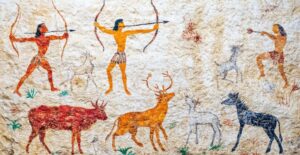
The earliest mythological art appeared in caves and ritual sites. The cave paintings at Lascaux in France, dating back to around 15,000 BCE, depict animals such as bulls, horses, and deer. Many scholars interpret these images as linked to shamanistic beliefs, fertility rituals, and myths surrounding hunting and survival. In India, the Bhimbetka cave murals portray hunting scenes, dancers, and spirit-like figures, reflecting early mythic narratives tied to nature and communal life. Egypt’s tomb paintings transformed mythology into afterlife guides, while Mesopotamian reliefs, such as those depicting Gilgamesh or cosmic battles between gods and monsters, presented mythology as a way to explain order and chaos in the universe.
These early mythological artworks were humanity’s first attempts to explain nature, mortality, and cosmic order through images. They laid the foundation for later religious and sacred art traditions across cultures.
Mythological Painting in Ancient Civilisations
Across ancient civilisations, painting functioned as a visual language through which societies recorded beliefs, values, and systems of power. These images acted as cultural scripts, allowing myths to be understood and remembered even in communities where oral tradition dominated daily life.
Across cultures, artists relied on shared symbols such as the sun, lotus, thunderbolt, and sacred animals to represent divine presence. These symbols created a visual shorthand that transcended language.
Cultural Diversity in Mythological Art
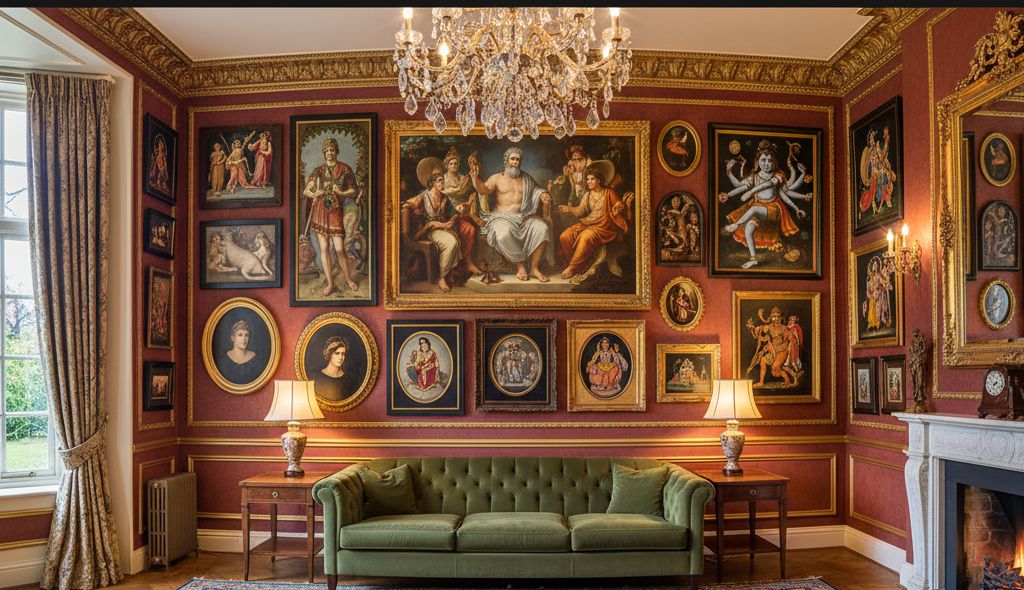
Across civilisations, mythological paintings reveal the inner architecture of belief. Each culture projected its gods, heroes, and fears differently.
- Greek and Roman Mythological Painting

Greek mythology had a significant impact on the visual arts, where gods, heroes, and mythological creatures were central subjects. The depiction of gods like Zeus, Athena, and Apollo reflected the Greek understanding of the human condition, the divine, and the cosmos.
Greek mythological paintings centred on gods, goddesses, and heroes because these figures represented idealised human traits. The gods were powerful yet flawed. Heroes were brave but vulnerable. This balance made mythological subjects deeply relatable.
Roman artists adopted Greek mythology almost entirely, often reinterpreting Greek gods with Roman names. Roman mythological paintings emphasised grandeur, realism, and political symbolism. Famous Greek and Roman Mythological Paintings:
- The Birth of Venus by Sandro Botticelli (c. 1485): Iconic depiction of the goddess emerging from the sea.
- Saturn Devouring His Son by Francisco Goya (c. 1820-1823): A dark, terrifying vision from the myth of the Titan Kronos.
- The Abduction of Europa by Rembrandt (1632): Zeus, disguised as a bull, carries Europa away.
- Indian Mythological Painting

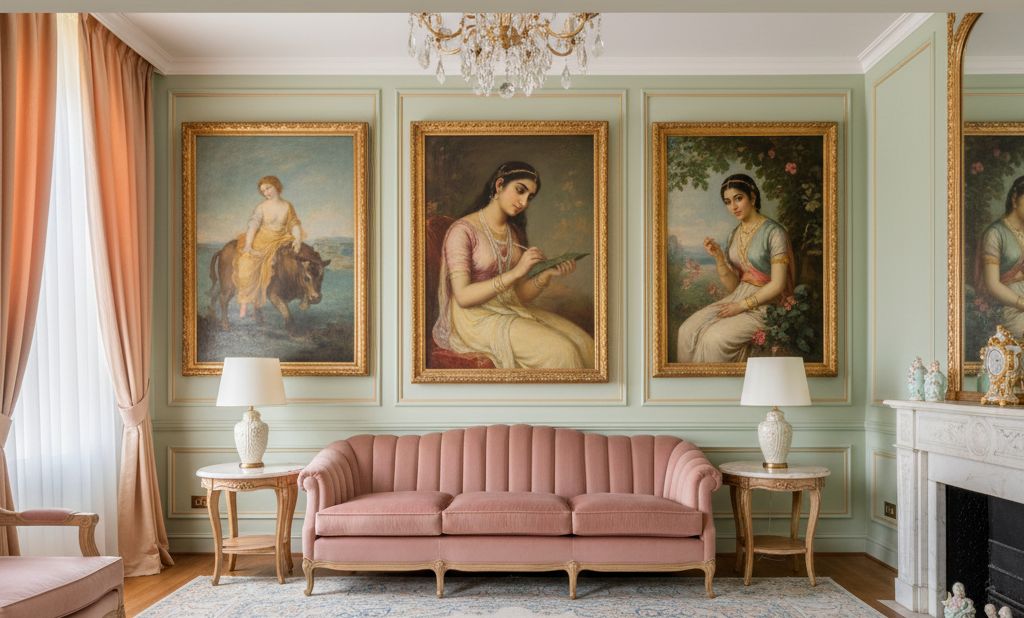
In India, mythological painting is deeply intertwined with religion, philosophy, and daily life. Indian mythology draws heavily from epics such as the Ramayana, Mahabharata, and sacred texts like the Bhagavad Gita and the Puranas.
Indian mythological paintings often depict gods such as Krishna, Rama, Shiva, Vishnu, and Durga. These figures are shown performing divine acts, teaching moral lessons, or participating in cosmic events. Unlike Western mythology, Indian mythological art emphasises spiritual symbolism over physical realism.
Miniature painting traditions, such as Mughal, Rajput, and Pahari schools, played a major role in visualising mythological stories.
Famous Indian Mythology Paintings:
- Raja Ravi Varma’s “Shakuntala” is among the paintings that most Indians recognise. It’s one of the most popular works by Indian artist Raja Ravi Varma.
- M.V. Dhurandhar, an academic painter from Bombay, created many mythological works, one of the most notable being “Sita in Ashok Vatika.” This painting depicts a poignant scene from the Ramayana, where Sita, the wife of Lord Rama, is held captive by Ravana, the demon king of Lanka.
Read More About Famous Indian Mythological Paintings
- Egyptian Mythological Painting
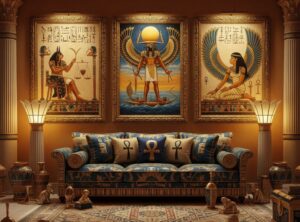
Egyptian mythology focused on the afterlife, cosmic balance, and divine kingship. Mythological paintings in Egypt followed strict conventions, emphasising clarity and symbolism rather than realism.
Gods such as Osiris, Isis, Anubis, Ra, and Horus were depicted with human bodies and animal heads, symbolising their divine functions. Scenes from the Book of the Dead illustrate judgment rituals, where the heart of the deceased is weighed against the feather of truth.
Egyptian mythological paintings were meant to ensure protection, rebirth, and eternal order.
Famous Egyptian Paintings:
Famous Egyptian mythological “paintings” are typically vibrant tomb murals and detailed illustrations on papyrus scrolls, rather than canvas paintings in the modern sense. These
- The Judgment of Hunefer: This famous papyrus from the Book of the Dead is perhaps the most iconic depiction of the Egyptian afterlife myth. It illustrates Hunefer’s heart being weighed against the feather of Ma’at (truth and justice) by Anubis.
- Tomb of Nefertari Murals: The walls of Queen Nefertari’s tomb are adorned with some of the most intricate and well-preserved paintings in ancient Egypt. Many scenes depict the Queen in various mythological scenarios.
- Norse Mythological Traditions
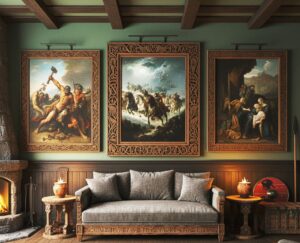
Norse mythology, originating in Scandinavia, centres on themes of fate, conflict, and the inevitable end of the world, known as Ragnarök. Mythological art from this tradition often depicts gods like Odin, Thor, and Loki, along with epic battles and mythical creatures.
While fewer ancient paintings survive from Norse culture, later European artists, particularly during the Romantic period, revived Norse mythology in dramatic paintings filled with movement and emotion.
Famous Norse Mythology Paintings:
- Åsgårdsreien (The Wild Hunt of Odin) (1872) by Peter Nicolai Arbo: A dramatic depiction of Odin leading spectral riders across the sky, a central image in Scandinavian folklore.
- Thor’s Fight with the Giants (1872) by Mårten Eskil Winge: Shows Thor in fierce combat with giants, emphasising the raw power and detail of the mythical battle.
- The Death of Balder (1893) by Fernand Khnopff: A moody, symbolist take on the tragic death of the beloved god Balder.
Symbolism In Mythological Paintings

Symbolism in mythological paintings acts as a second language, a code beyond the visible. Every motif, such as an eagle, a serpent, or a lotus, meant more than form.
- The lotus, representing purity and rebirth
- The serpent, symbolising transformation or chaos
- The sun represents creation and divine authority
- Wings, signifying divinity or transcendence
- Tree of Life connects worlds across cultures
Weapons, representing power, justice, or fate
Masterpieces at Giftex
January 2026 marks the return of the much-awaited Giftex Modern and Contemporary Art Auction. Showcasing masterpieces by both emerging and established artists, the auction brings together a compelling range of works across diverse media and themes. From bold contemporary expressions to refined modern classics, this edition promises something for every art lover and collector. Stay tuned for a celebration of creativity, vision, and artistic excellence.
Cultural Legacy of Mythological Paintings
Mythological painting continues to influence modern art, cinema, literature, and popular culture. Contemporary artists reinterpret ancient myths to address modern themes such as identity, power, and morality.
Museums, textbooks, and visual media keep these images alive, reminding us that mythology is not a relic of the past but a living framework through which humans continue to explore meaning.
Mythological paintings endure because they connect art with storytelling, belief, and shared memory. They remind us that across time and geography, humanity has always turned to images to understand the mysteries of existence.


About Post Author