What Are Rare Books From Colonial India and Why Collectors Seek Them
In an era defined by digital screens and fleeting content, rare books and antique engravings continue to hold a quiet yet enduring appeal. Their value lies not only in nostalgia but also in their ability to engage both the senses and the intellect. These objects carry ideas, images, and perspectives across time, preserving histories that cannot be fully translated into digital form.
In India, a land rich with literary, spiritual, and artistic heritage, rare books from the colonial period occupy a distinctive place. These rare Indian books record an era marked by cultural encounter, documentation, and transformation. For collectors, these works offer more than historical reference. They combine visual richness, material craftsmanship, rarity, and layered narratives, making them enduring objects of study, appreciation, and desire.
In this guide, we explore what rare books from colonial India are and why collectors and book lovers seek them.
The Literary Heritage of India
India’s literary history spans over 3,000 years, beginning with the oral traditions of the Vedas and ancient scriptures eventually recorded on palm leaves and birch bark. For centuries, knowledge was transmitted orally or through painstaking manual copying.
The arrival of the printing press in India in the sixteenth century marked a turning point. Early presses were introduced by Portugal missionaries, followed by colonial administrations and private publishers. By the eighteenth and nineteenth centuries, print culture expanded rapidly, producing books on history, travel, science, religion, linguistics, and governance.
Colonial-era printing transformed how India was documented, interpreted, and circulated globally. These historical books from India from the colonial era form the core of what collectors now recognise as rare books from Colonial India.
What Are Rare Books From Colonial India?

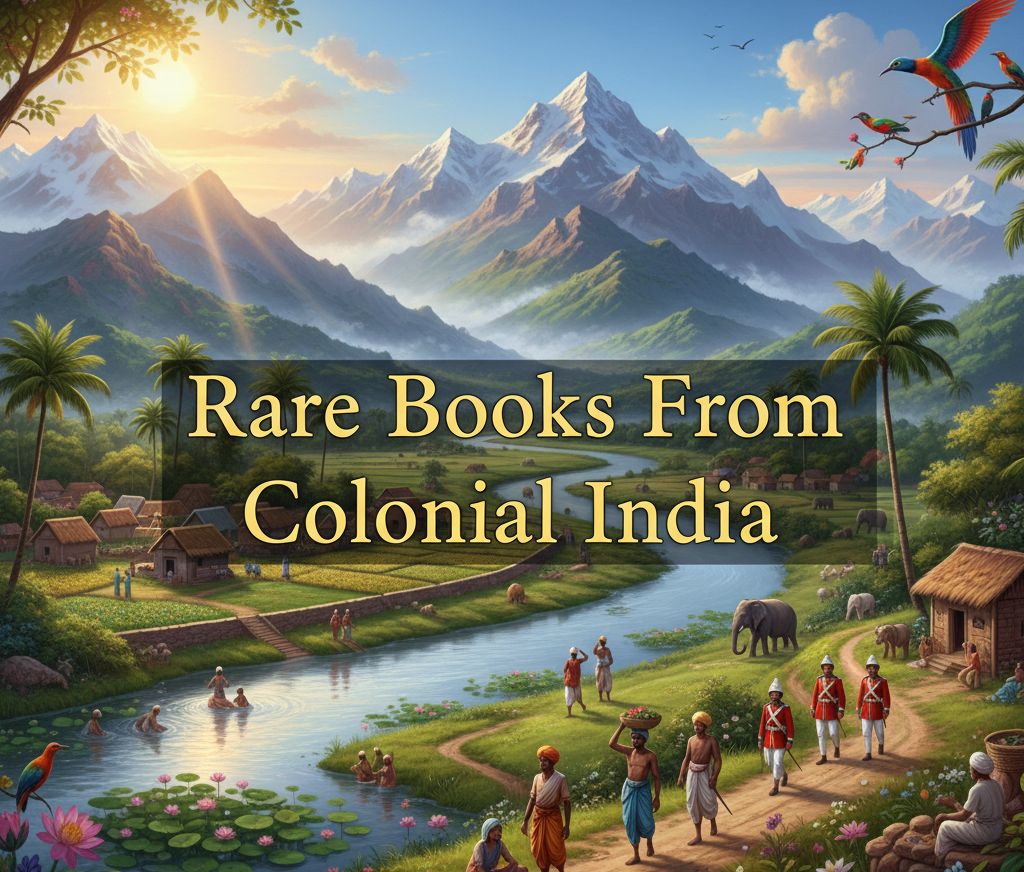
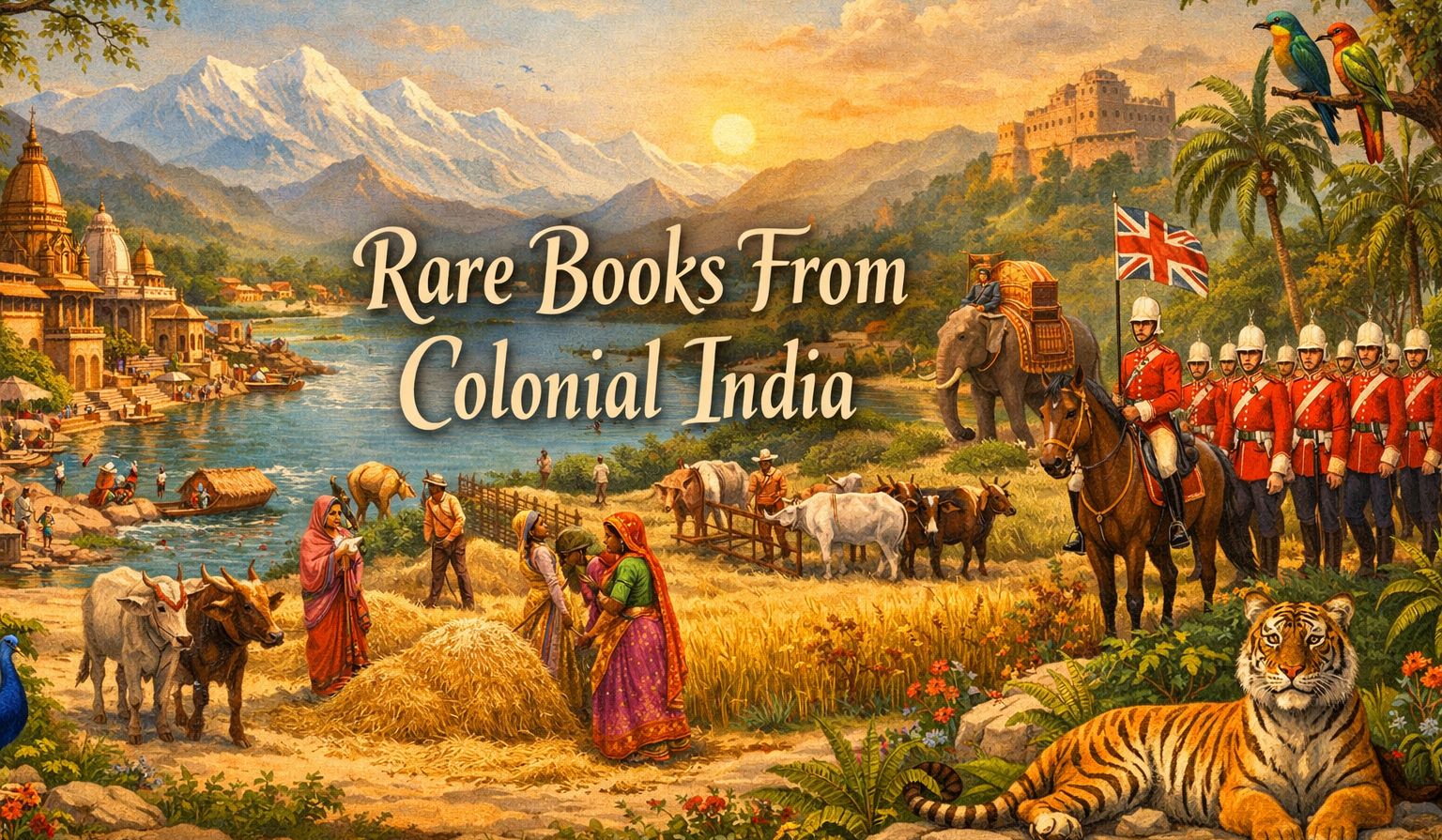
Rare books from Colonial India broadly refer to printed works produced during the period of British rule, roughly from the mid-eighteenth century to the early twentieth century. These books often focus on India’s land, people, languages, history, and customs, viewed through both colonial and indigenous perspectives.
These include:
- Travelogues & Explorations: These include diaries, letters, and published narratives by European travellers, officials, and missionaries describing Indian landscapes, religions, and customs. Early accounts of India by Europeans, like Frederick Shoberl’s Hindoostan, were full of cultural descriptions and hand-coloured engravings.
Hindoostan, Volumes I–VI: Edited by Frederic Shoberl: This set of three books comprising six volumes, Hindoostan, offers a comprehensive account of the religion, manners, customs, trades, arts, sciences, literature, and recreations of the Indian subcontinent and was sold at a past Giftex auction, where it emerged as a crowd favourite.
- Botanical & Scientific Studies: Colonial India was extensively surveyed. Early botanical books documenting Indian flora and fauna are prized for their scientific importance and exquisite illustration. These volumes often include hand-coloured plates.
- Linguistic & Missionary Texts: Manuals and records from missionaries documenting local languages and customs. These works are invaluable records of linguistic history.
- Military Memoirs & Histories: First-hand accounts of colonial military life and events. Books recounting military campaigns, frontier life, and hunting expeditions were popular during the colonial era. Jim Corbett’s Man-Eaters of Kumaon remains one of the most sought-after examples.
This set of three classic works by Jim Corbett was the collector’s favourite during a past Giftex auction. titles included Man-Eaters of Kumaon, The Temple Tiger and More Man-Eaters of Kumaon, and The Man-Eating Leopard of Rudraprayag.
- Fine Art & Illustrated Books: Books featuring original prints, like W. Egerton’s “Illustrated Handbook of Indian Arms”, or stunning engravings of Indian life.
The Artistic Value of Antique Engravings
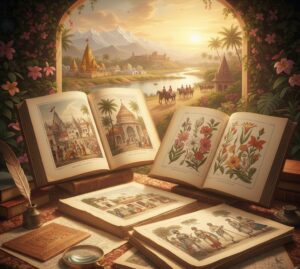
Before the invention of photography, engravings were the only way to share visual depictions of the world. In the 18th and 19th centuries, European artists documented India’s landscapes, temples, and people through detailed engravings.
These images were not merely artistic; they were historical records. They captured the “Golden Age” of Indian architecture and the untouched natural beauty of the Ganges. Some of the most iconic works were produced by:
- Thomas & William Daniell: Famous for their aquatints like Twelve Views of Calcutta, documenting colonial city life and landscapes.
- James Baillie Fraser & Charles D’Oyly: Other European artists whose landscape paintings served as studies for engravings, shaping colonial visual culture.
- Robert Grindlay, celebrated for his picturesque cityscapes.
- Raja Ravi Varma (1848-1906): The “father of modern Indian art,” he democratized art by using lithography to print his paintings of Hindu epics, making them accessible to the masses through his Ravi Varma Press.
- Nandalal Bose (1882-1966): A key figure in the Bengal School, he illustrated the Indian Constitution and used linocut for his popular depictions of village life and mythology.
Why Collectors Seek Colonial Indian Books
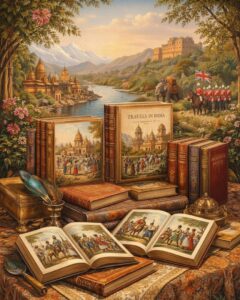
Collectors are drawn to colonial Indian books for several overlapping reasons.
- Historical Insight
These books provide first-hand documentation of India’s social structure, political systems, religious practices, and everyday life during a transformative period. They capture moments of encounter between cultures, often revealing as much about the observer as the observed.
- Artistic and Material Beauty
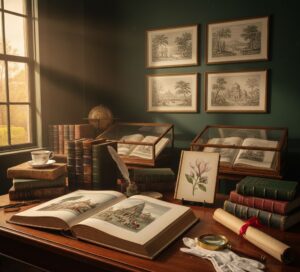
Many colonial-era books were produced with remarkable craftsmanship. Fine bindings, handmade paper, marbled endpapers, and detailed engravings elevate these books beyond textual records into works of art.
- Scarcity and Survival
Print runs were often limited, and many books were lost to climate, neglect, or political upheaval. Surviving copies, especially those in good condition or complete with plates, are increasingly rare.
- Investment Potential
As interest in South Asian history and material culture grows globally, rare colonial Indian books have shown steady appreciation in value, particularly those with strong provenance or visual content.
- Personal and Cultural Connection
For Indian collectors, these books offer a way to reclaim and reinterpret historical narratives. For international collectors, they represent a crucial chapter in global history.
Tips for First-Time Collectors
Starting a collection can be daunting. Here is how to begin your journey:
- Define Your Focus: Don’t try to “collect India.” Pick a niche—perhaps maps of Bombay, books on Indian birds, or first editions of 20th-century Indian novelists.
- Check the Condition: Look for “foxing” (brown spots), wormholes, or brittle pages. While some wear is expected, the more original the binding, the higher the value.
- Verify the Plates: In illustrated books, ensure no engravings have been “excised” (cut out). A book missing its map or its frontispiece is worth significantly less.
- Buy from Reputable Sources: This ensures the item’s authenticity and helps you understand its true provenance.
Also Read: A Guide to Literary Auction
A World of Collectibles: The Giftex Auction
For those ready to transition from admirer to owner, the Giftex “A World of Collectibles” Auction is an unmissable event. Known for curating some of the finest rarities in the country, Giftex brings together a premier selection of rare books, including rare books from Colonial India.
Whether you are looking for rare travelogues, detailed military memoirs, or stunning botanical engravings, our curated auctions offer a transparent and exciting platform to acquire history. These books are not just items on a shelf; they are legacies you can hold in your hands.
Stay tuned for our upcoming auction updates. Don’t miss your chance to start or elevate your collection with pieces that define the very soul of Indian history.
Final Thoughts
Rare books from Colonial India are more than just “old books.” They are a tangible link to our ancestors, a record of our landscape’s transformation, and a testament to the enduring power of the printed word. For collectors, these books offer intellectual depth, artistic beauty, and lasting value. In preserving them, collectors help ensure that these complex histories remain accessible, questioned, and understood for generations to come.


About Post Author