
How to Tell If Your Book Is a First Edition (Without Guessing)
Picture this. You’ve spent months combing through auctions, estate sales, and second-hand bookshops. Finally, you spot it. A copy of a famous rare book, perhaps The Great Gatsby, is tucked quietly on a shelf. Or maybe you pull an old copy of the first Harry Potter novel from your attic, forgotten for years.
The excitement is immediate. But then the question hits: Is this a first edition?
The key to success in the world of rare book collecting lies in one crucial skill: the ability to identify true first editions. So, what are first editions? It can mean the difference between a modest keepsake and a book worth tens of thousands of dollars. Understanding how to identify first editions is one of the most important skills a collector can learn.
This guide breaks it down clearly. No jargon overload. No guessing games. Just practical steps to help you determine whether the book in your hands is truly a first edition.
Also Read: Rare Book Provenance: A Guide
What Is A First Edition Book?
https://www.youtube.com/watch?v=JhKhDyYCyn0
Video Credit: Antique Book Collective
A book is only a first edition if it is in its ‘original form’ – the version printed and shared with the public for its initial release. That’s the broad definition. But collectors usually mean something more specific: the first edition, first printing.
Why does this matter? Because later printings can still be labelled “first edition” by publishers, even though they were produced after the initial run. For collectors, those later printings are usually far less valuable.
So, when identifying first editions, you’re almost always looking for the earliest possible version of a book as it was first released to the public.
The Difference Between a First Edition and a First Printing
At first glance, the terms “first edition” and “first printing” sound interchangeable. For collectors, they are not.
When a book is published for the first time, it is referred to as the first edition. That edition can include multiple printings; all produced from the same basic setup of type or plates.
A first printing refers specifically to the very first batch of books produced. Later printings of the same edition may be nearly identical in appearance, but they are usually less desirable to collectors.
This distinction matters because value is typically highest for copies that are both:
- First edition
- First printing
Collectors often refer to this as a “1st/1st.”
A Famous Example of First Edition Confusion: 1984 by George Orwell
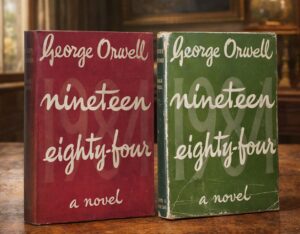
Few books illustrate the confusion surrounding first editions better than 1984 by George Orwell.
The novel was published in 1949 in both the United Kingdom and the United States. The UK hardcover edition, issued by Secker & Warburg, is generally accepted as the true first edition.
Where things become murky is the dust jacket.
The Secker & Warburg first edition exists with two different dust jacket colours: red and green. Both are authentic, both are period-correct, and both were issued in 1949. The problem is that no definitive publisher records survive to confirm which jacket was printed first.
How to Verify If Your Book Is a True First Edition
So how do you know if the copy you’re holding is the real first edition? While there’s no single rule that applies to every book, there are several practical steps you can take to verify what you have.
- Look for Explicit Publisher Statements
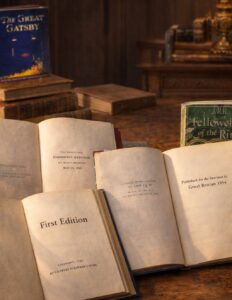
The first place to check is the copyright page. Many publishers, especially in the 20th century, clearly stated when a book was a first edition.
Phrases to look for include:
- “First Edition”
- “First American Edition”
- “Published for the first time in…”
While helpful, these statements should be treated with caution. Some publishers continued to label later printings as “First Edition,” even after the initial run sold out.
Think of these statements as a starting point, not final proof.
- Understand the Number Line (Printer’s Key)
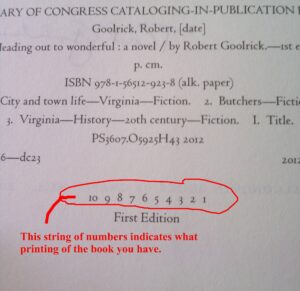
One of the most reliable tools for identifying modern first editions is the number line, also called the printer’s key.
The number line is a sequence of numbers (and sometimes letters) printed on the copyright page. Common examples include:
- 1 2 3 4 5 6 7 8 9 10
- 10 9 8 7 6 5 4 3 2 1
- 9 8 7 6 5 4 3 2 1
The rule is simple: the lowest number present indicates the printing.
If the number “1” appears anywhere in the sequence, the book is usually a first printing. If the lowest number is “2,” it’s a second printing. A number line such as “3 5 7 9 8 6 4” means your book is not from the first printing.
Pro tip: The order of the numbers doesn’t matter. What matters is the lowest number that remains.
- Compare Copyright and Publication Dates
Dates can offer another important clue.
In many cases, a true first edition will have a copyright date that matches the publication date listed on the title page. If you see later dates added, it can suggest a subsequent printing.]
That said, dates are not always straightforward. Sometimes the copyright is secured before the book is actually published, which means the publication date may appear slightly later. Minor differences don’t automatically disqualify a first edition, but large gaps often do.
- International Printings and “True” First Editions
Things get more complicated when a book is published in multiple countries.
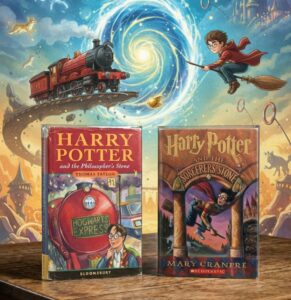
A true first edition is generally considered the earliest printing released anywhere in the world, not just in one country. If a book debuts in the UK and is published in the US shortly afterwards, the UK edition is usually regarded as the true first.
A famous example is Harry Potter and the Philosopher’s Stone. The book was first published in the United Kingdom, making the UK first edition the true first. The American edition, retitled Harry Potter and the Sorcerer’s Stone, came later and is far less valuable to collectors.
- First Editions and Antique Books
Identifying first editions becomes far more challenging with antique books, especially those printed before the 19th century.
Early publishers did not use consistent edition markings, print runs, or copyright pages. You won’t find a neat “First Edition” label in books from the 16th, 17th, or 18th centuries.
By the 19th century, some publishers began noting editions, but the language can be misleading. Terms like “new edition” or “corrected edition” might sound promising, but often indicate later states, not true firsts.
For books from this period, collectors rely on:
- Pagination and format
- Known printing errors
- Binding styles
- Paper quality and watermarks
- Dust Jackets
In these cases, expertise matters. Serious collectors often consult specialists or institutional references before deciding.
- Dust Jackets and First Editions

Dust jackets might not seem like a big deal, but they can play a key role in identifying and valuing first edition books. These protective covers, also called dust wrappers, weren’t always part of a book’s design until the late 19th century.
For collectors, dust jackets are often as important as the book itself.
Hidden Clues Found on Dust Jackets
Dust jackets aren’t just decorative. They often contain details that help distinguish early printings from later ones.
When examining a dust jacket, look for:
- Unclipped corners showing the original printed price
- Early blurbs or reviews that reflect the book’s initial release
- Author biographies that match the author’s career stage at publication
- Period-correct publisher logos or typography
- Use Bibliographies and Research Tools
When in doubt, bibliographies are invaluable.
A bibliography is a detailed reference that documents an author’s works, including publication history and known points of issue. These guides often list the exact characteristics of true first editions, from spelling errors to binding variations.
Some bibliographies are so authoritative that they’ve become collectibles themselves. John Eckel’s bibliography of Charles Dickens, for example, is still a cornerstone reference for Dickens collectors.
Final Word on Verification of First Edition
No single detail proves a first edition on its own. Verification is about building a case using multiple pieces of evidence. The more signs align, the more confident you can be.
The market for first edition books is both complex and rewarding. According to recent findings, even minor variations in edition identification can result in dramatic price differences. For collectors, this means that understanding the nuances of first edition identification isn’t just about authenticity – it’s about protecting and maximising investment potential. Today’s rare book market demands more than just enthusiasm; it requires detailed knowledge and careful analysis. And sometimes, even with famous books and extensive research, uncertainty remains. That’s part of what makes rare book collecting both challenging and fascinating.


About Post Author