
Paintings That Disappear: The Mystery of Fore Edge Paintings in Books
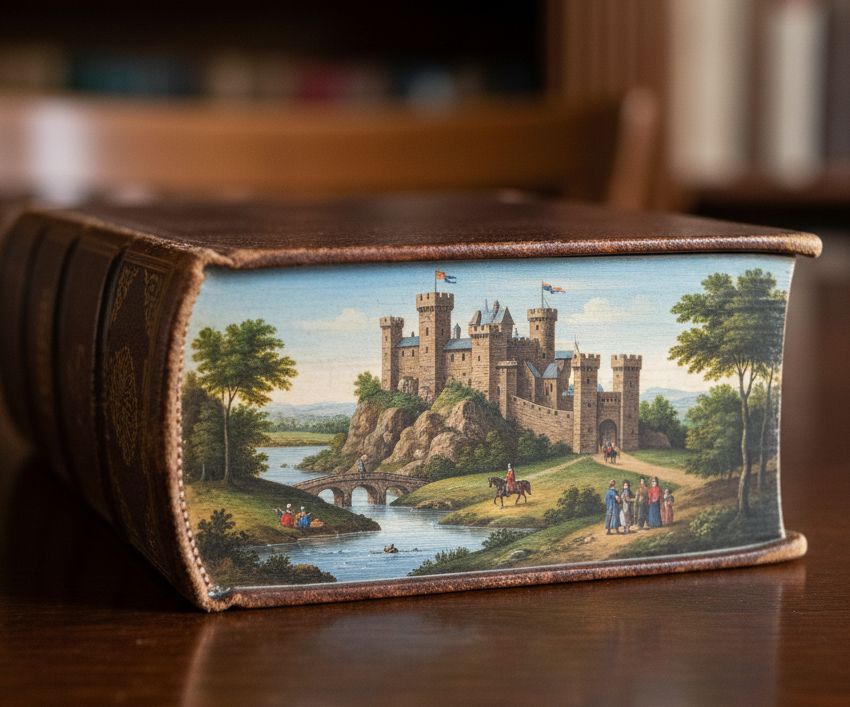
Have you ever noticed the decorated edges of your rare books? Sometimes gilded, marbled, or painted, these embellishments give the book a more precious appearance. Fore-edge painting is one of the most fascinating decorative techniques found in rare and antique books. It combines art, craftsmanship, and secrecy. In many cases, the artwork remains hidden until the pages are fanned. Because of this feature, collectors and historians have shown strong interest in these books. Moreover, fore-edge painting books are closely associated with luxury bookbinding traditions. They were often created for wealthy patrons, collectors, and libraries. As a result of painting on book edges and creating a masterpiece, these books are now considered valuable cultural artefacts.
Today, fore-edge-painted books are widely studied and collected. Their artistic beauty, rarity, and historical value have increased their demand in the rare book market.
Also Read: Provenance in Rare Books
What Is A Fore-edge Painting?
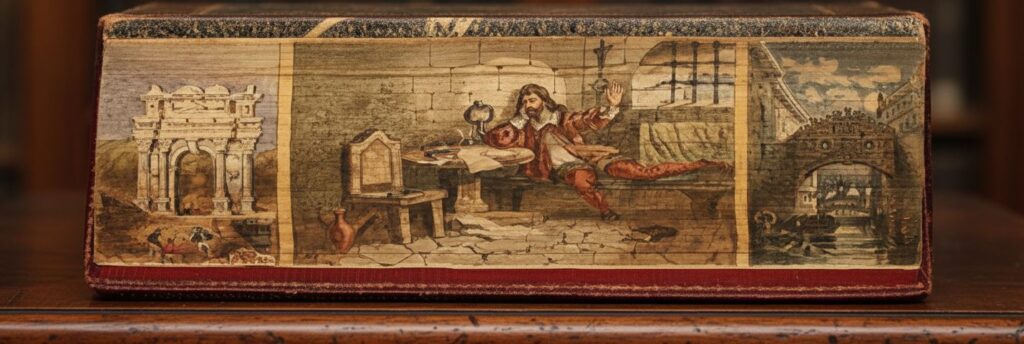
A fore-edge painting is an image painted on the fanned pages of a book. The “fore-edge” is the long side of the book furthest away from the spine. This technique renders the painting completely invisible when the book is closed and hidden beneath a shimmer of gilt or marble. But, if you fan the pages just right, what’s revealed may be a secret pastoral landscape, a royal portrait, a cityscape, or a rising cathedral—as if conjured by sleight of hand.
- Early Beginnings
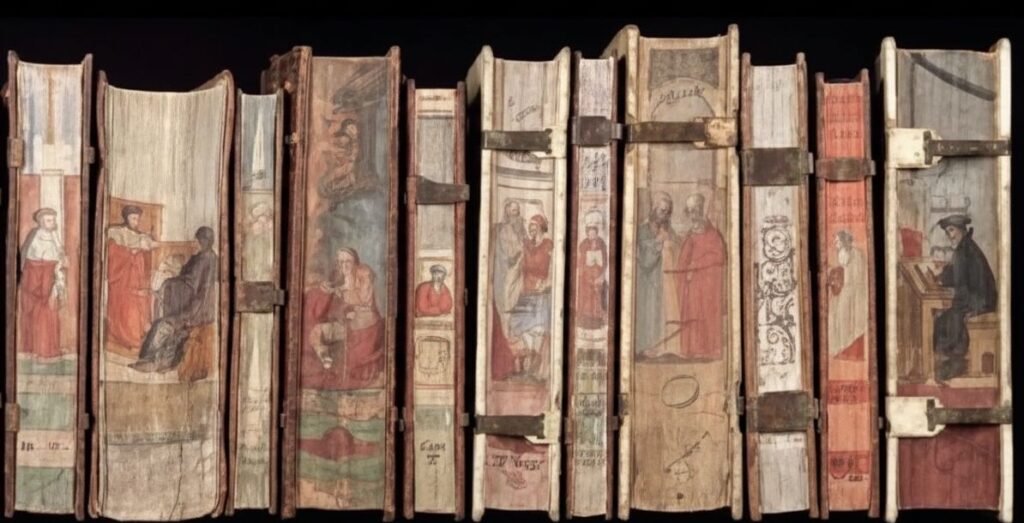
Books have not always been produced in the form that readers recognize today. In early manuscript traditions, the design and identification of books followed different conventions. During the 10th century, book titles were not placed on the spine as they are today. Instead, titles were written or tooled onto the fore edge, which is the outer edge of the pages opposite the spine.
This method served a practical purpose. At that time, books were often stored flat on shelves rather than upright. Because of this arrangement, the fore edge was the most visible part of the book. As a result, writing the title on this edge enabled readers to identify the books easily.
However, book design gradually evolved. By the 16th century, advances in printing and bookbinding changed the way books were labelled and stored. Titles began to be placed on the spine of the book. Consequently, the fore edge was no longer required for identification.
In many cases, book owners chose to decorate this space. Their names, coats of arms, or family crests were often painted or stamped onto the fore edge.
- The First Decorative Fore Edge Paintings
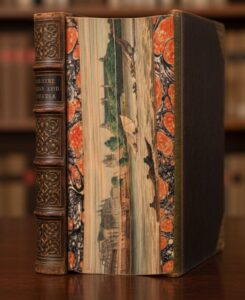
During the 1500s, the idea of transforming the fore edge into a miniature canvas began to develop. One of the figures associated with this early innovation was the Italian painter and engraver Cesare Vecellio. Instead of using the fore-edge for the title or owner’s name, Vecellio imagined painting a distinctive work of art there using the page edges as a blank canvas. When the book remained closed, the artwork could be clearly seen along the edge. Landscapes, decorative motifs, and symbolic images were sometimes painted in this way.
- Disappearing Fore-Edge Painting

In the 1600s, an artist and one of England’s greatest bookbinders, Samuel Mearne, took the book-painting idea and made it even more interesting.
Instead of painting directly on the flat edge of the closed book, Mearne introduced a new method. The pages were gently fanned, creating a slanted surface along the inner edges of the paper. The artist then painted the image across this exposed surface.
Once the paint had dried, the book was closed again. When the pages returned to their natural position, the painting disappeared from view. As a result, the artwork could only be seen when the pages were fanned once more.
The picture became a disappearing, vanishing or hidden fore-edge painting that you couldn’t see unless you fanned the pages.
- The Addition of Gilded Edges
Another important feature was soon incorporated into the process. After the hidden painting was completed, the outer edges of the pages were often covered with gilt, which is a thin layer of gold applied to the page edges.
Gilding served several purposes.
- First, it enhanced the visual beauty of the book.
- Second, gilding helped protect the pages.
- Finally, the gilt layer helped conceal the hidden painting. When the book was closed, the edges appeared completely golden, giving no hint that an image existed beneath the surface.
Types of Fore Edge Paintings
- Single Fore Edge Painting
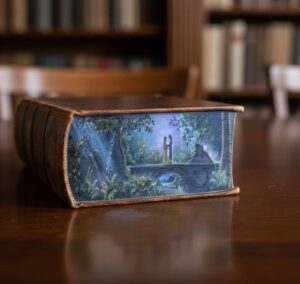
This is the most common type. Only one painting appears when the pages are fanned in one direction.
When the book is closed, the edges may appear gilded, marbled, or plain.
- Double Fore Edge Painting
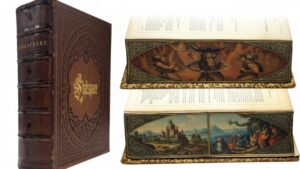
In double fore-edge paintings, two different images are hidden on the same edge.
One painting becomes visible when the pages are fanned forward. Another appears when the pages are fanned backwards.
This technique requires exceptional skill. Therefore, such books are considered highly collectible.
- Triple and Panoramic Fore Edge Paintings
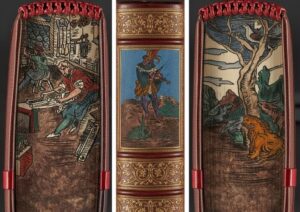
Although rare, triple fore-edge paintings also exist. Three separate images can be revealed depending on how the pages are fanned.
Panoramic paintings are another variation. These images extend across the entire edge to form a wide scene.
Fore Edge Painted Books in Rare Book Collecting
Why Collectors Value Them
Fore-edge painted books are highly valued by rare book collectors. Several factors contribute to their collectability.
- First, they represent a unique combination of art and literature. The book itself is valuable. At the same time, the painting adds an artistic dimension.
- Second, the craftsmanship involved is remarkable. Each painting was created by hand.
- Third, many of these books were produced in limited numbers. Therefore, surviving copies are rare.
Because of these reasons, fore-edge painted books are often sought after at auctions and rare book fairs.
Preservation and Care
Because fore edge painted books are delicate, proper care is essential.
- First, they should be stored in a stable environment. Excess humidity or heat can damage the paper and paint.
- Second, direct sunlight should be avoided. Light exposure can cause fading.
- Third, handling should be minimized. When the pages are fanned repeatedly, the paint may gradually wear away.
Therefore, many collectors keep these books in protective cases or archival boxes.
Modern Fore Edge Painting

Although the tradition began centuries ago, fore-edge painting still exists today.
Some contemporary artists continue to create new examples. In many cases, modern books are decorated using traditional techniques.
These works are often produced for collectors or special editions. As a result, the art form continues to survive.
Final Thoughts
Fore-edge painting remains one of the most enchanting features in antiquarian and rare books. The technique combines artistic skill with bookbinding craftsmanship.
Moreover, hidden fore-edge paintings add an element of mystery. Because of their rarity and beauty, these books are highly collectible. Libraries, museums, and private collectors continue to preserve them.
Although the practice began centuries ago, interest in fore-edge painting remains strong today. As a result, these hidden artworks continue to captivate book lovers around the world.
Giftex: A World of Collectibles Auction
This March, Giftex brings back its much-loved “A World of Collectibles” Auction. A carefully curated collection of antique and vintage treasures will be presented, offering something special for collectors and treasure hunters alike.
From rare collectibles to timeless vintage pieces, the auction promises discoveries that celebrate history, craftsmanship, and nostalgia


About Post Author