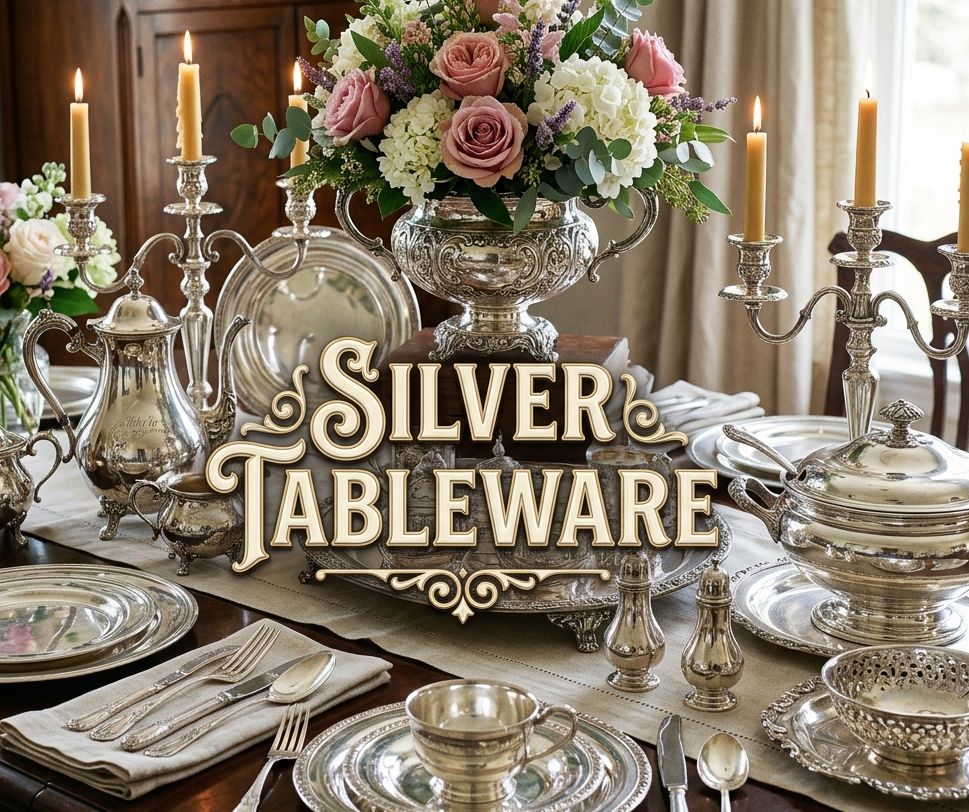
The Story of Silver Tableware: From Royal Courts to Modern Homes
India’s relationship with silver runs deep, tracing back millennia. From royal courts to middle-class homes, silver has always been more than a precious metal — it is a symbol of purity, wealth, and auspiciousness. From antique silver collectibles, such as silver mirrors and silver sculptures, to vintage silver treasures like silver tableware, silver flatware and silverware dinner sets, silver in India occupies a unique position, blending functionality with cultural significance.
Even as lifestyles have modernised, this connection hasn’t faded. Many families still bring out their silver glasses, bowls, and thalis during festivals, weddings, and religious rituals.
This association with silver spans every layer of society. In royal courts of the past, finely crafted antique and vintage silverware have always played a key role. This story begins in antiquity and continues to today’s modern households, where silver still reigns supreme, especially during important occasions.
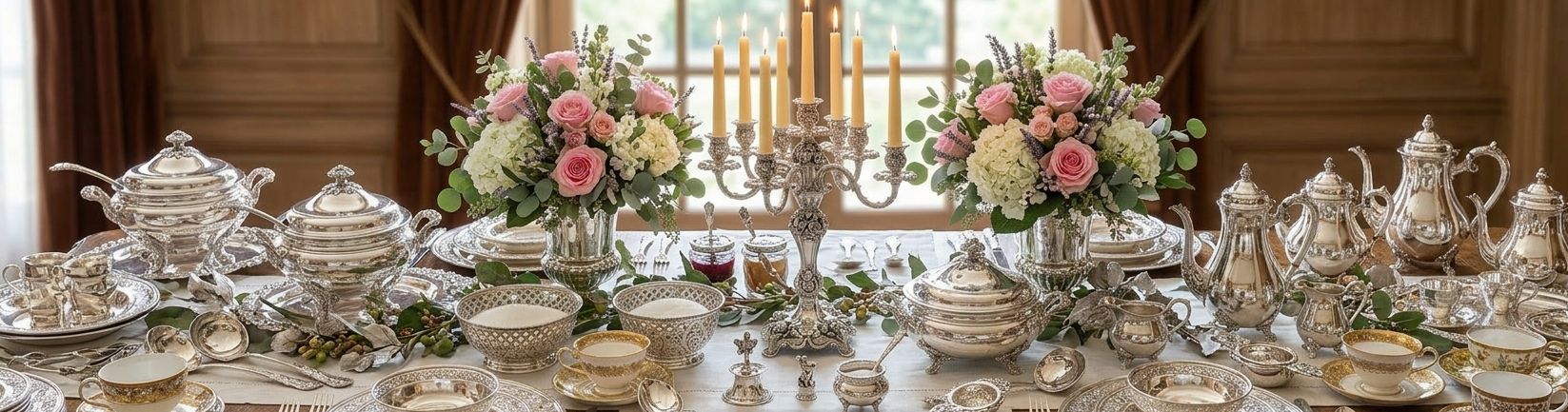
Also Read: The Art of Styling Silver Centrepieces
Ancient Beginnings
The Indian Story
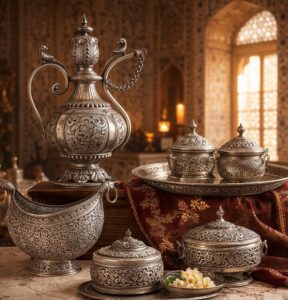
- The earliest references to silver tableware in India can be traced back to the Vedic period. Texts and archaeological findings suggest that silver was valued not only for its beauty but also for its believed medicinal properties.
- In ancient royal courts, kings and nobles dined from silver thalis, katoris, and goblets. This wasn’t just a display of wealth. It was tied to ideas of health, hygiene, and ritual purity.
- As time moved into the Mughal and Rajput eras, silver tableware reached remarkable artistic heights. Thalis, bowls, and goblets were often intricately engraved with floral motifs, vines, and geometric patterns.
Silverware Around the World
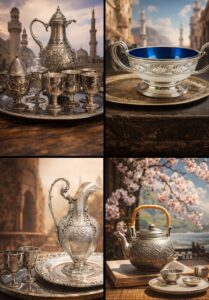
Outside India, silver tableware also has deep roots.
The oldest known silver objects used for dining date back to ancient Egypt and the Roman Empire. In these civilizations, silver was associated with wealth and divine favour.
During the early Middle Ages in Europe, silver cutlery and vessels were largely restricted to monasteries and the high nobility. The average person used wood, clay, or pewter. Silver signalled power and access.
The Rise of Silver Flatware
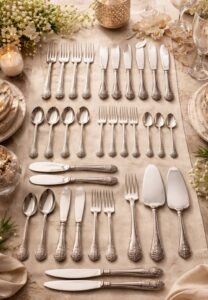
Silver flatware, as we recognize it today, began to take shape in the 19th century. It quickly became a staple of formal dining, especially in Europe and America.
Dinner parties during this time were elaborate affairs. A single meal could include anywhere from five to eighteen courses. Each course required its own specific utensil.
A typical sterling flatware collection might include:
- Dinner forks and knives for the main course
- Salad forks, slightly smaller and designed for lighter dishes
- Soup spoons with deeper bowls
- Dessert spoons and forks for sweets
- Fish knives and forks, shaped to handle delicate fillets
- Oyster forks, small and narrow for shellfish
- Butter knives for spreading
- Cake knives and pie servers for desserts
This level of detail reflected the dining culture of the time. Knowing which utensil to use and when was part of social etiquette.
Types of Silver Tableware
Silver tableware can broadly be divided into two main categories: flatware and hollowware.
Flatware
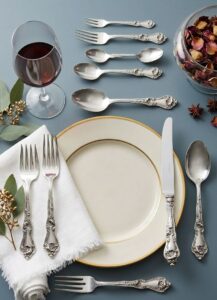
Flatware refers to the utensils used for eating and serving food. These are typically smaller, handheld items designed for individual use.
Common types include:
- Forks: Variants include dinner forks, salad forks, and dessert forks.
- Knives: Dinner knives are standard, while butter knives are smaller and less sharp.
- Spoons: Soup spoons are rounder and deeper, while dessert spoons are smaller.
- Serving utensils: These include larger items like serving spoons, ladles, and tongs, used to transfer food from shared dishes to individual plates.
Hollowware
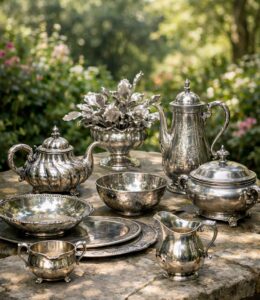
Hollowware refers to larger, often hollow, vessels used for serving, preparing, or displaying food and drink.
Types of hollowware include:
- Tea and coffee sets: Typically include a teapot, coffee pot, sugar bowl, and milk jug.
- Serving bowls: They can range from simple to heavily ornamented.
- Trays and platters: Flat surfaces used to present or carry food and drinks.
- Covered dishes (tureens): Designed to keep food warm while serving.
- Centerpieces: Decorative items that sit in the middle of the table, sometimes functional, sometimes purely ornamental.
Key Historical Styles in Silver Tableware
Silver tableware has evolved across regions and time periods, with each era leaving behind a distinct visual language.
- Indian Silver
Indian silverware stands apart for its richness in detail and cultural storytelling.
Common characteristics include:
- Floral and nature-inspired motifs such as lotuses, creepers, and mango patterns
- Religious and mythological engravings
- Handcrafted techniques like repoussé (raised work), chasing, and deep engraving
Mughal-influenced designs, on the other hand, introduced more refined floral patterns and Persian-inspired symmetry.
- The Renaissance
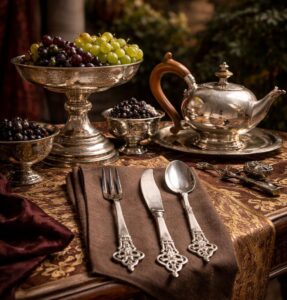
The Renaissance marked a turning point. Silverware began to evolve from purely functional objects into works of art. Craftsmen experimented with form, symmetry, and decoration. Pieces were designed not just to be used but to be admired.
- The Baroque Era
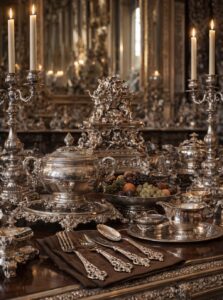
The Baroque period pushed this even further. It was an age of excess and display. Royal courts across Europe competed in opulence. One of the most famous examples comes from the court of Louis XIV, where entire table settings at Versailles were crafted from solid silver. This included cutlery, candlesticks, serving dishes, and even decorative centerpieces.
- Georgian Style
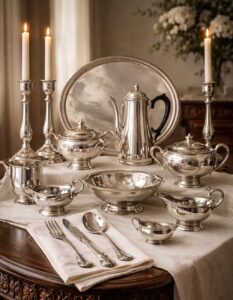
The Georgian era in Britain marked a shift toward elegance and proportion. Silverware from this period is known for its balance and understated beauty.
Key features include:
- Clean, symmetrical forms with minimal ornamentation
- Smooth, polished surfaces with occasional subtle engraving
- Classic shapes, such as oval trays and gently curved handles
5. Victorian Style
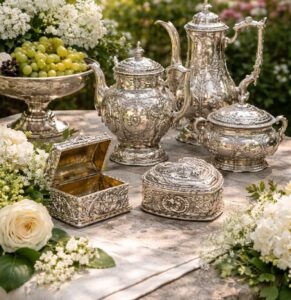
The Victorian period brought a dramatic change. With industrial progress and a growing middle class, silverware became more elaborate and widely available.
Typical elements include:
- Highly decorative surfaces, often with dense engraving
- Floral, scroll, and shell motifs
- Heavier construction, giving a sense of grandeur
- Art Deco (1920s–1930s)
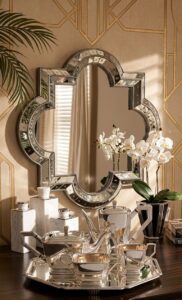
Art Deco marked a clear shift toward modernity.
Defining traits include:
- Bold geometric patterns
- Sleek, streamlined shapes with sharp lines
- Minimal decoration, focusing instead on form and symmetry
Where to Find Antique and Vintage Silver Tableware
If you’re looking to add authentic silver pieces to your collection, auction houses are often the best place to start.
In recent years, online auctions have made this process much easier. You no longer need to be physically present to access quality collections. Platforms like Giftex, with their curated selection, have become a reliable destination for discovering antique and vintage silver tableware.
Why Silver Still Matters
Even today, silver tableware holds a special place. Although it may not be used daily in most homes, it is often seen during celebrations, weddings, and festivals. It carries a sense of occasion.
There are practical reasons too. Silver has natural antimicrobial properties, which is why it was historically associated with health. But more than anything, silver tableware endures because of what it represents. It tells stories. A slightly worn spoon might have been part of countless family meals. A carved tray might have been a wedding gift decades ago.
In a world that moves fast and favours convenience, silver invites you to slow down. To set the table with care. To treat a meal as something worth honouring.
Giftex: A World of Collectibles Auction
This March, Giftex returns with its A World of Collectibles auction. The event brings together a thoughtfully curated selection of pieces, ranging from antique and vintage furniture to decorative art and silverware.
For collectors and enthusiasts, it’s an opportunity to discover unique finds, each with its own history and character.


About Post Author