
Blue of the Ancients: The Enduring Spell of Lapis Lazuli Jewellery
Exotic and alluring, the rich and deep hue of lapis lazuli is stimulating to the touch and mesmerising to behold. Few gemstones command attention in quite the same way. Its blue is not soft or shy. It is bold, saturated, and unmistakably ancient. Blue is one of the rarest colours found in nature, and for much of human history, it was almost unattainable. Up until the 18th century, whether you were a Pharaoh or a painter, there was only one place on Earth where true blue could be found in its natural form: the high, remote peaks of north-eastern Afghanistan.
Historians believe the relationship between humans and lapis lazuli stretches back more than 6,500 years. Long before diamonds symbolised wealth or gold became currency, this blue stone travelled vast distances, crossing deserts and seas, prized by the great civilisations of Mesopotamia, Egypt, China, Greece, and Rome. In this guide, we explore the history of lapis lazuli jewellery, its origins, meanings, and the antique jewellery forms that continue to inspire collectors today.

Also Read: The Enduring Allure of Sapphire Jewellery
What Is Lapis Lazuli?
Lapis lazuli is one of the oldest gemstones known to humanity, treasured for its intense deep blue colour often flecked with golden pyrite and streaks of white calcite. The finest lapis has a rich, even blue with minimal white veining and subtle pyrite inclusions that shimmer like distant stars. This distinctive appearance makes lapis instantly recognisable and impossible to imitate convincingly.
Where Does Lapis Lazuli Come From?
Afghanistan has been the primary source of lapis lazuli for millennia. The legendary mines of Badakhshan, located in the rugged mountains of the country’s north-east, are believed to have been in continuous operation for over 6,500 years. From these remote peaks, lapis lazuli travelled along early trade routes into Mesopotamia, Egypt, the Indus Valley, and eventually Europe.
What Does Lapis Lazuli Mean?
The meaning of Lapis Lazuli can be derived from its Latin source.
The name reflects both simplicity and colour. “Lapis” is Latin for stone, while “lazuli” comes from the Medieval Latin lazulus, derived from the Arabic lazward, meaning blue. The word itself gave rise to terms like “azure,” reinforcing how deeply lapis influenced humanity’s understanding of blue.
The Journey of Lapis Lazuli Through History
The story of lapis lazuli runs alongside the story of civilisation itself. Its path can be traced across continents, cultures, and thousands of years of human creativity.
- Ancient Afghanistan

Lapis was first mined in the mountains of ancient Afghanistan around 7000 BCE, where its vivid blue colour set it apart from any other material known at the time. From there, it travelled far beyond its place of origin.
- Ancient Egypt

In ancient Egypt, lapis became a sacred stone, closely linked to the heavens, protection, and the promise of rebirth. It adorned the jewellery of pharaohs and was placed in tombs to safeguard the soul in the afterlife. It was also ground into powder for eyelid cosmetics, famously used to line the eyes of royalty and priests.
- Mesopotamia
In Mesopotamia, lapis lazuli became a cornerstone of trade and artistic expression. It was carved into seals, amulets, and ceremonial objects. Physicians in antiquity even prescribed powdered lapis for medicinal purposes, believing it could cure ailments of the soul as well as the body.
- Greek and Roman Era
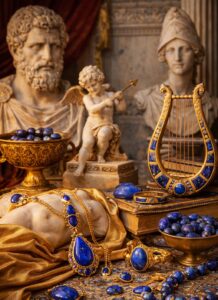
The Greeks and Romans embraced lapis as a mark of wealth and refinement, valuing it not only for its beauty but also for its perceived mystical and protective qualities.
The Romans referred to lapis as “sapphirus,” a name later applied to the blue corundum we now call sapphire. They believed lapis to be an aphrodisiac and wore it as a charm for desire and protection
- Renaissance

During the Renaissance, lapis reached new heights of prestige. Ground into ultramarine pigment, it produced the most brilliant and expensive blue ever used in art, reserved for the most important religious figures and commissions.
Michelangelo famously used lapis lazuli pigment for the blue hues in the Sistine Chapel frescoes.
Top 5 Lapis Lazuli Jewellery
The magic of Lapis Lazuli continues in the modern era with this beautiful blue stone embedded in various jewellery pieces. Here are the top 5 Lapis Lazuli jewellery pieces that will make any jewellery collection shine:
- Lapis Lazuli Bracelets
Lapis lazuli bracelets have appeared in many forms across history, from early bead strands worn for protection to refined gold-mounted examples created for the royal court. Over time, craftsmanship became more precise, with polished beads, carved plaques, and inlaid designs set into gold or silver. Today, lapis bracelets retain this sense of permanence, valued for their weight, colour, and quiet authority.
- Lapis Lazuli Necklaces
Among the earliest lapis adornments, necklaces have been worn since ancient Egypt, where strands of lapis beads were reserved for the elite. These evolved through the centuries into more structured forms. Whether simple or elaborate, lapis necklaces have always been defined by the stone’s deep blue presence rather than excessive ornamentation.
- Lapis Lazuli Earrings
The pairing of lapis lazuli with diamonds reflects the meeting of colour and light. While early earrings relied solely on gold settings, later periods introduced diamonds to frame and enhance lapis. This combination reached particular refinement in high jewellery, where lapis cabochons or carved drops were balanced by diamond detailing.
- Lapis Lazuli Rings
Rings made from lapis lazuli have long been associated with authority and personal identity. Ancient signet rings were carved with symbols or inscriptions, while modern lapis rings often feature architectural settings or diamond accents, reinforcing the stone’s dignified and commanding character.
- Lapis Lazuli Evil Eye Pendants
The Evil Eye motif draws on one of lapis lazuli’s oldest associations: protection. From ancient talismans to finely crafted pendants, lapis has been shaped into symbols believed to ward against harm. These pieces have evolved in form but not in meaning, continuing to be worn close to the body as objects of belief as well as beauty.
The Enduring Appeal of Lapis Lazuli in Fine Jewellery
What sets lapis lazuli apart from other gemstones is not brilliance or transparency, but presence. Its colour is immediate and unmistakable, carrying with it thousands of years of cultural meaning.
In fine jewellery, lapis lazuli has always been chosen deliberately. Its opaque depth demands confident design, careful setting, and an understanding of balance.
Caring for Lapis Lazuli Jewellery
As a natural stone, lapis lazuli requires thoughtful care. It is softer than many gemstones and should be protected from harsh chemicals, excessive moisture, and abrasive surfaces. Lapis jewellery is best cleaned gently with a soft cloth and stored separately to avoid scratching.
A Legacy Etched in Blue
Lapis lazuli has appeared in many corners of history and continues to hold its place in the modern world. What once adorned the sacred temples of ancient Egypt can still be seen today on contemporary runways and within fine jewellery collections.
These remarkable pieces highlight lapis lazuli’s enduring role across centuries, reflecting both its historical significance and its lasting fascination in jewellery design. From ritual and reverence to refined adornment, lapis lazuli remains a stone that transcends time, carrying its legacy forward in deep, unmistakable blue.


About Post Author