
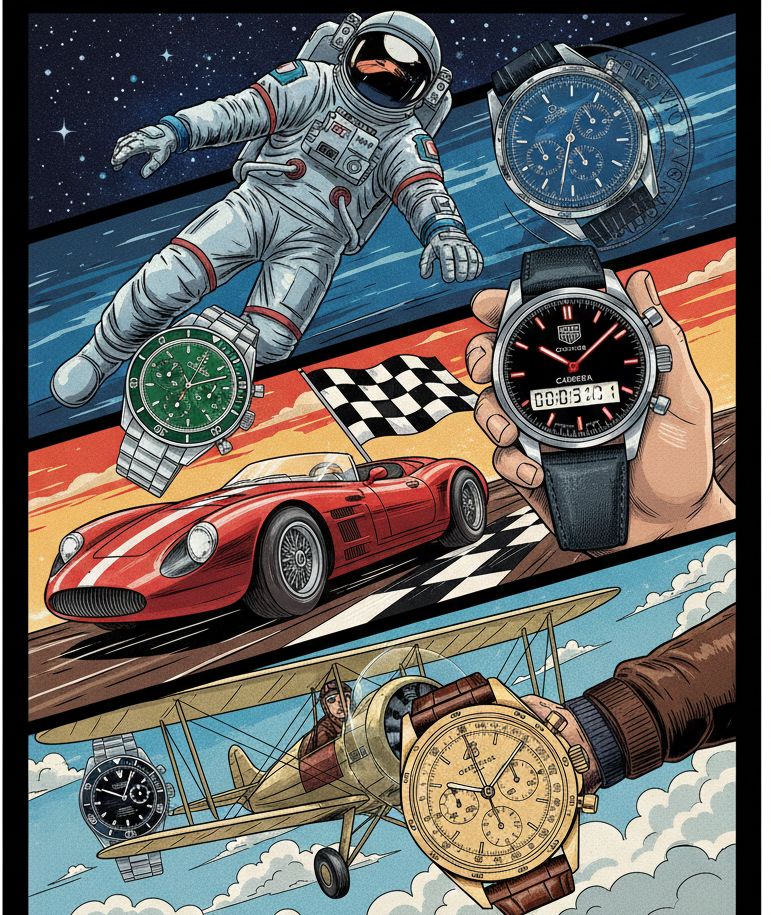
From Racetracks to Apollo Missions: The Story of the Chronograph
Luxury watches have come a long way. Time measurement is an ancient technique that has existed for aeons. Sundials and water clocks were in use thousands of years ago, which developed into clock towers that could chime out for a whole village to hear. It was then that the watch, a device that a person can carry in their pocket, emerged. Pocket watches then gave way to wrist watches. Antique luxury watches are not just instruments. They are heirlooms, engineering marvels, and expressions of identity. Nothing captures the imagination like antique and vintage luxury watches. There is something about their weight, their quiet precision, and their history that modern gadgets cannot match.
The world of horology is a treasure trove of intricate complications and innovations. Among these complications lies one with a history that is as rich and complex as its function: the chronograph.
Knowing the hour was not enough. People needed a way to measure time in motion. Racing horses, sailing ships, scientific experiments, and later rockets and aircraft all demanded accuracy down to the second. That need sparked a revolution that led to the birth of the chronograph.
In this guide, we explore the history of chronographs, what are its functions are, and why they have become one of the most admired complications in watchmaking.

Also Read: All About Vintage Watch Dials
What Is a Chronograph?
The word chronograph is built from Greek roots, “chrono” coming from time, and “graph” meaning to write.
A chronograph is any watch that can measure elapsed time using an independent sweep seconds hand. At its core, a chronograph is a watch with a built-in stopwatch. It allows you to start, stop, and reset a separate timing system without interfering with the watch’s main timekeeping.
https://www.youtube.com/watch?v=hLPnc7CQ7lA
Video Credit: Wrist Unwound
The Birth of the Chronograph
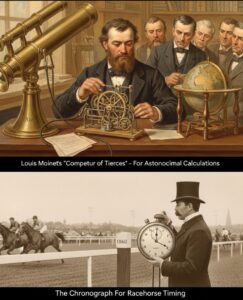
The rise of global seafaring in the 1700s made accurate timekeeping more important than ever. The first real chronograph was invented by Louis Moinet in 1816 to assist with the working of astronomical equipment. Louis Moinet was a French horologist and a personal advisor to the legendary Abraham-Louis Breguet.
For years, credit for creating the chronograph was attributed to Nicolas Mathieu Rieussec, who, in 1821, was commissioned by the French King Louis XVIII to create a device that could time horse races. A groundbreaking revelation in 2013 shattered the conventional narrative and set the spotlight on Louis Moinet.
How Do Chronograph Watches Work?
Chronographs rely on dedicated mechanics inside the movement. Because they are analogue timers, they are more complex than a standard watch. They use three train wheels to manage measurement:
- One wheel tracks running seconds.
- One wheel measures elapsed minutes.
- One wheel measures elapsed hours.
When you press the start pusher, the timer activates. When you press stop, the mechanism halts. When you reset, all hands snap back to zero. Inside, levers, cams, gears, and clutches move in harmony to make that simple action possible.
The Role of Chronographs in Aviation
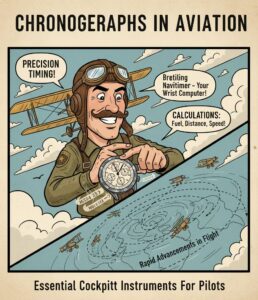
Aviation played a pivotal role in the development and popularisation of the chronograph. In the early 20th century, the world was witnessing rapid advancements in flight, and aviators needed precise instruments.
Chronographs became essential cockpit instruments worn on the wrist.
The Breitling Navitimer combined a chronograph with a slide rule bezel, giving pilots a compact computer in the days before digital navigation.
From Earth to Space: The Ultimate Test
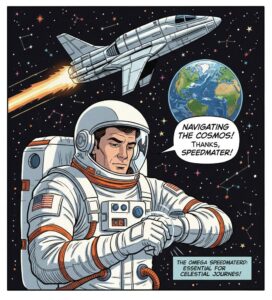
Few watches have faced a trial like the Omega Speedmaster. NASA tested countless watches for extreme conditions: vacuum, heat, cold, shock, and vibration. The Speedmaster survived them all.
During the Apollo 13 mission, when the power failed and digital systems shut down, the astronauts relied on a simple chronograph timing sequence to execute a critical engine burn. Their lives depended on precise timing, and the chronograph delivered.
That moment sealed the chronograph’s place in history.
Known as the “Omega Moonwatch,” the Speedmaster was worn by NASA astronauts during the Apollo missions, enabling the Apollo 13 astronauts to navigate their crippled spacecraft safely back home, making it one of the most iconic chronographs in history.
Chronographs in Motorsports
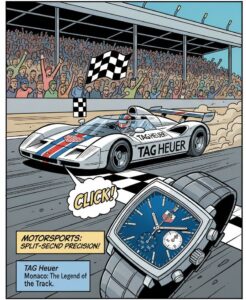
Motorsports offered another stage where split seconds mattered. Racers and pit crews relied on chronographs to track performance, lap times, and mechanical behaviour. Watch brands saw the excitement around racing and stepped in.
Rolex partnered with racing circuits. TAG Heuer, long linked to motorsports, created iconic racing chronographs that became legendary.
Chronographs were built to withstand vibrations, shocks, and speed. They became part of the uniform for drivers and teams. Their bold designs reflected the energy of competition.
The Evolution of Chronographs: From Tool to Luxury
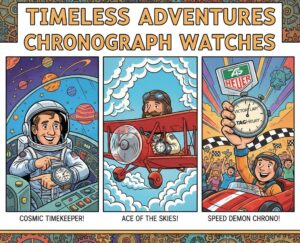
As aviation and motorsports made chronographs famous, the complication slowly transformed. It was no longer only a tool. It became a marker of status, craftsmanship, and mechanical skill.
Brands began to refine aesthetics. Cases became slimmer. Pushers became sleeker. Dials gained balance and beauty. The chronograph evolved from a practical gear to a luxury statement.
Collectors began valuing mechanical movements, rare variations, and historical references. The chronograph moved from airfields and racetracks into boardrooms and showrooms
Even so, it never lost its purpose. It remained functional, even when wrapped in gold or platinum.
The Charm of Chronographs: Why We Love Them
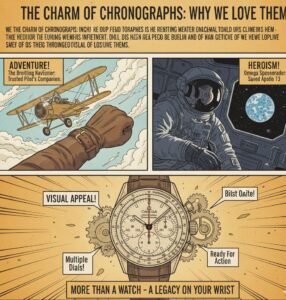
Chronographs have a pull that other complications cannot match. Part of it is technical. Part of it is emotional.
First, there is the romance tied to adventure. Chronographs have been strapped to the wrists of risk takers. Think of the Breitling Navitimer, a trusted companion for pilots navigating early aviation. Think of the Omega Speedmaster, the watch that guided the Apollo 13 crew when their spacecraft lost power and timers. In that moment, a chronograph helped bring astronauts home. It is hard to beat a legacy like that.
Second, there is the visual appeal. Multiple subdials, pushers, hands, and scales give chronographs a sense of purpose. They look ready for action even when sitting still.
Third, there is the story. Every chronograph marks time in a way that feels personal. It can measure a race. It can time a memory. It can freeze a moment.
The Legacy of the Chronograph Today
Today, the chronograph stands for technical mastery, innovation, and luxury. It remains one of the most admired complications among collectors. It appears in countless iconic models, from the Omega Speedmaster to the Rolex Daytona, and many more.
The chronograph continues to inspire new generations of watchmakers. It stays relevant not because we need it to time horse races or space missions, but because it carries history on the wrist.
It does not just measure seconds. It captures moments worth remembering.


About Post Author