

Inside the Mind of an Art Auction Bidder: Art Auction Psychology
Art has always held a unique place in human life. Paintings and other creative works are not merely objects; they are experiences, emotions, and expressions. For many collectors, art is acquired for deeply personal reasons. Love of beauty, emotional connection, intellectual curiosity, and even social identity are often involved. Because of these layered motivations, the process of collecting art becomes far more complex than a simple purchase.
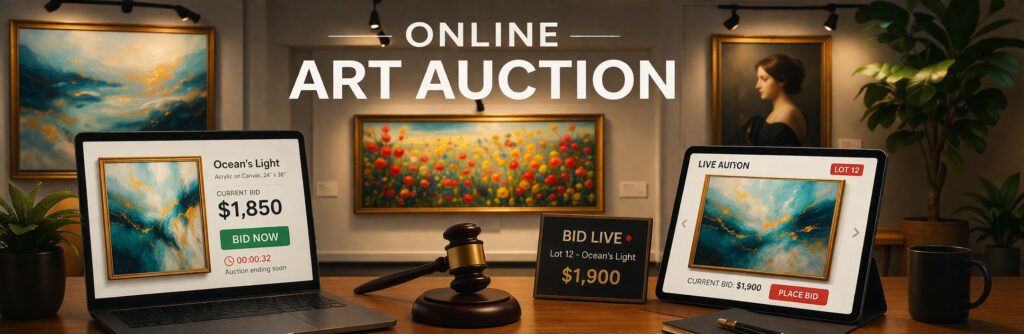
In recent years, online art auctions have become a preferred method for acquiring artworks.
However, it should be understood that an online auction is not only about price. Decision-making, timing, and human behaviour are constantly at play. While many participants enter auctions with basic knowledge, experienced bidders rely more on discipline and mindset than on speed or instinct. Therefore, an understanding of bidding psychology becomes essential. It allows collectors to develop structured strategies, improve outcomes, and avoid unnecessary financial risk.
Learn More About Modern Indian Art Here.
Why Art Is Collected

At the most fundamental level, art is collected because it is loved. Emotional satisfaction is often cited as the primary reason behind purchases. In many cases, artworks are not simply chosen; they are “fallen in love with.” A strong personal connection is felt.
A sense of ownership and control is established, which strengthens attachment.
Moreover, collecting is not purely emotional. It is also intellectual. Knowledge about art history, techniques, artists, and cultural contexts is continuously developed. Thus, collecting art is shaped by both passion and learning.
Why Psychology Matters in Online Auctions
When participation takes place in an online auction, behaviour is rarely driven by logic alone. Emotions such as excitement, fear, urgency, and competition often influence decisions. Therefore, auction psychology plays a central role in determining outcomes.
Key Psychological Factors in Art Auctions

Several psychological mechanisms are consistently observed in online art auctions.
-
Auction Fever and Competition

A strong sense of competition is created during auctions. Even in online settings, this effect is not reduced. A “hunter” instinct is often triggered. As bidding intensifies, the focus is shifted from acquiring the artwork to winning the contest.
-
The Endowment Effect
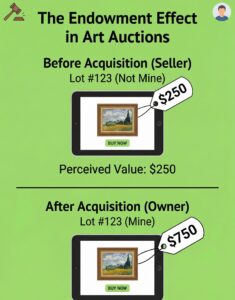
As soon as interest is developed in a piece, a sense of ownership begins to form. Even before the artwork is acquired, it is mentally “possessed.” Because of this, losing the item feels like a personal loss. To avoid that loss, higher bids are often justified internally.
-
Scarcity and Exclusivity
Art is inherently scarce. Most pieces are unique. Additionally, auctions are time-limited. Because of this combination, urgency is created.
-
Social Proof and Herd Behaviour
When multiple bidders show interest in an artwork, its value appears to be validated. Each new bid acts as a signal. Others are encouraged to participate.
-
Emotional Investment and Status
Art is often linked to identity and status. A piece may be desired not only for its beauty but also for what it represents socially. Emotional attachment is strengthened. Financial reasoning may be overridden.
-
The Competitive Escalation Effect
Competition is deeply embedded in human behaviour. From an evolutionary perspective, losing a contest is associated with negative outcomes. In auctions, this instinct is activated. A psychological state known as competitive arousal is created.
In this state, the desire to win becomes dominant. Rational thinking is reduced. As a result, escalation occurs.
Practical Strategies to Manage Bidding Psychology
Success in online art auctions is rarely accidental. The following strategies are designed to help bidders stay in control, make informed decisions, and improve their chances of securing desired artworks without overpaying.
-
Prepare Before Entering the Auction
Preparation is considered the foundation of successful bidding. Without it, decisions are more likely to be driven by confusion or excitement.
- Before joining an auction, the catalogue should be reviewed carefully.
- Each artwork should be studied in detail, including its background, condition, and provenance.
- In addition, the past performance of similar works should be analysed across platforms.
- Most importantly, a fixed budget should be set in advance.
-
Use Anchoring to Your Advantage
The starting bid or pre-sale estimate plays a powerful role. It acts as a reference point. Since the opening bid or estimate influences perception, it should not be accepted blindly.
Instead, independent research should be used to form a personal valuation. This value should act as the true anchor, rather than the auction’s starting point.
-
Stay Rational During Live Bidding
Live bidding environments are designed to create a sense of urgency. Prices move quickly, and hesitation can feel risky. However, successful bidders do not allow speed to dictate their actions.
A conscious effort should be made to slow down mentally. Each bid should be evaluated against the pre-decided limit. If the price exceeds that limit, withdrawal should be immediate and without regret.
-
Observe and Understand Competitor Behaviour

Every auction includes a mix of personalities and strategies.
Some bidders act aggressively from the start, while others remain silent until the final moments.
By recognizing these behaviours, more informed decisions can be made. Timing can be adjusted, and unnecessary bidding wars can be avoided.
-
Avoid Common Emotional Traps
Several psychological traps are commonly encountered in auctions, and they should be actively avoided.
- The urge to “win at any cost” is one of the most dangerous. When this mindset takes over, it leads to ignoring value and overspending.
- Similarly, chasing a bid simply to avoid losing leads to poor decisions.
- Another common mistake is assuming that a higher price always reflects higher quality or importance.
-
Detach Emotion from Decision-Making
Art naturally creates emotional responses. That is part of its appeal. However, during an auction, emotional attachment should be managed carefully.
It is helpful to remind oneself that missing one artwork does not mean losing all opportunities. Alternatives will always exist.
-
Stick to a Clear Exit Strategy

An exit strategy should be defined before bidding begins. This includes knowing exactly when to stop and being willing to walk away.
In the long run, walking away from an overpriced lot is considered a success, not a failure.
Common Psychological Mistakes to Avoid in Online Art Auctions
Emotional decisions are often responsible for poor outcomes in auctions. These mistakes may seem small in the moment, but they can lead to overspending and regret.
- Bids are chased just to avoid losing the item.
- Budget limits are ignored once competition increases.
- Higher prices are assumed to mean higher value.
- Decisions are influenced by other bidders.
- The urge to “win” overrides logical thinking.
- Fear of missing out drives unnecessary bids.
- Emotional attachment is formed too early.
- Bidding becomes reactive instead of strategic.
Avoiding these mistakes helps maintain control, protect budgets, and improve long-term success in online art auctions.
Final Thoughts
The psychology of bidding plays a critical role in online art auctions. While knowledge of art and market trends is important, it is not sufficient on its own. Behaviour must also be managed.
Successful bidders think ahead. Emotions are controlled. Clear strategies are followed. Decisions are not rushed. Reactions are not made blindly.
The next time a bid is about to exceed a pre-set limit, a pause should be taken. The situation should be assessed carefully. It should be asked whether the decision is being driven by the artwork or by the competitive environment.
In that moment, clarity is gained. And with that clarity, better decisions are made.
Giftex: Modern & Contemporary Indian Art Auction
This April, Giftex brings you a Modern and Contemporary Indian Art Auction, showcasing a thoughtfully curated selection of works by celebrated masters. Explore iconic pieces by renowned Indian artists and begin your journey into the world of fine art collecting.
Discover, collect, and begin your art journey this April with Giftex


About Post Author