
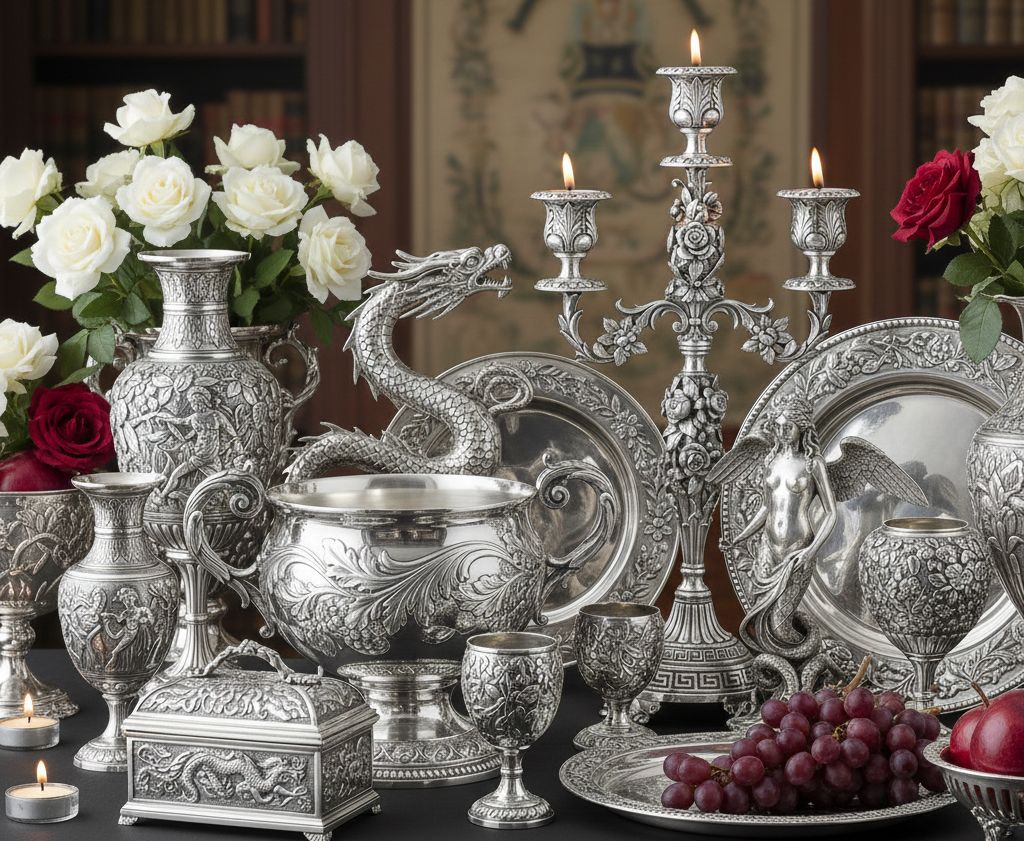
Silver Stories: The Motifs That Shaped Decorative Arts
There’s something quietly powerful about antique silver. Pick up an antique teapot or a vintage silver serving tray, and you’ll notice it isn’t just shaped metal. It tells a story. Tiny engraved flowers, proud lions, curling vines, geometric borders, even mythological creatures — all of them speak of the era, the maker, and the tastes of the time.
Fine craftsmen have always used a multitude of techniques to imbue their objects with beauty and visual appeal.
Silver has always been more than functional. Silver home décor items are used to add luxury, light, and sophistication to interiors.
When collecting antique or vintage silver decor items, examining the type of decorative motifs included by the artisan can provide insights into the object’s origin, age or intended function. These motifs reflect cultural values and artistic movement.
Let’s explore the popular silver motifs, how they evolved, and the recurring themes that continue to influence silver design today.
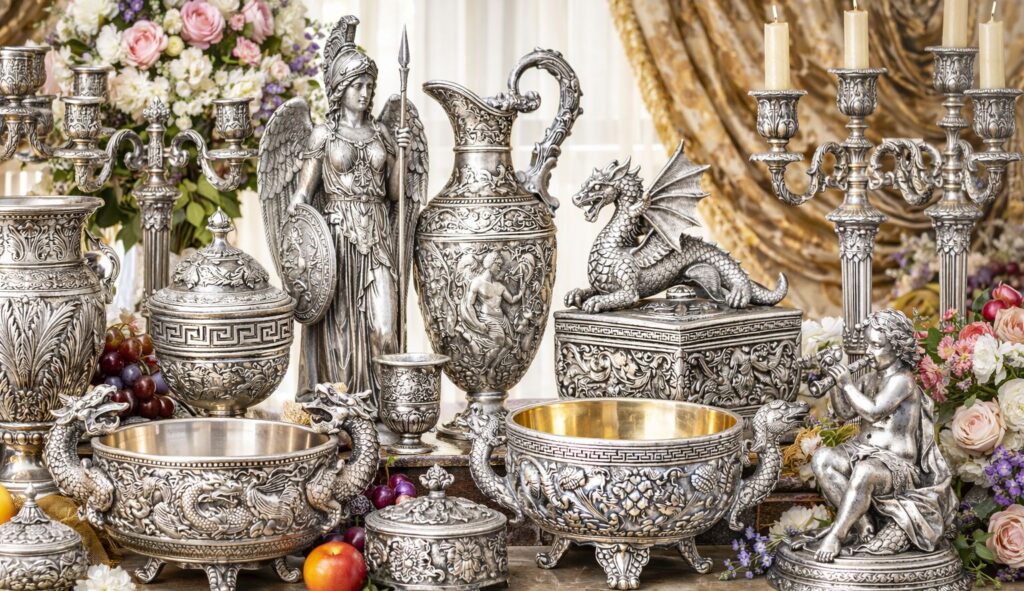
Also Read: Timeless Shine: Antique Silver in Home Décor
What Is a Motif?
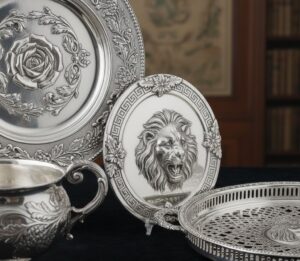
A motif is a recurring decorative element or pattern used in art and design. It can be a symbol, a shape, a figure, or a stylised form that appears repeatedly across objects.
In silver decorative arts, motifs might be engraved, embossed, repoussé-worked, chased, cast, or pierced into the surface. They serve both aesthetic and symbolic purposes. A rose might symbolise love. A lion might represent strength or nobility. A simple geometric border might reflect order and restraint.
Categories of Silver Motifs
While styles shift across centuries, most silver decorative motifs fall into a few major groups. These themes recur, evolving with changing tastes.
- Floral and Botanical Motifs
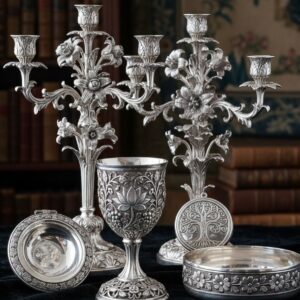
Floral motifs are perhaps the most enduring in silver design. They symbolise beauty, growth, fertility, and the natural world.
Common floral elements include:
- Roses, Lilies and Daisies: Passion, purity and innocence
- Acanthus leaves: The Acanthus leaf symbolises immortality, resurrection, and enduring life
- Grapes and vines: Intricate, organic designs often used in filigree work.
- Lotus: Symbolises purity, beauty, and divinity,
- Tree of Life: This motif represents growth, strength, and interconnectedness
In the 17th and early 18th centuries, especially during the Baroque period, acanthus leaves and scrolling vines were dominant.
During the Rococo period in 18th-century France and England, floral designs became more fluid and asymmetrical. Shell-like curves mixed with blossoms and foliage, creating movement and softness.
By the Victorian era in the 19th century, floral motifs became more naturalistic. Roses and ivy leaves were especially popular, reflecting romanticism and sentimentality.
In the Art Nouveau period, around 1890 to 1910, botanical motifs became elongated and stylised. Designers embraced flowing lines and organic forms. Silver pieces from this era often feature sinuous vines and delicate blossoms that seem to grow across the surface.
Even today, floral motifs remain common in both traditional and contemporary silverwork.
- Animal Motifs
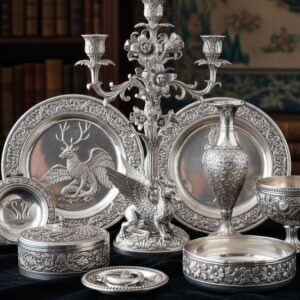
Animals in silver design often carry symbolic meaning. They can represent power, status, loyalty, or national identity.
Common animal motifs include:
- Peacock: Symbolises grace, beauty, and royalty
- Elephant: Represents wisdom, prosperity,
- Eagles: Power, strength and freedom
- Stags: Regeneration, royalty and spirituality,
- Dolphins: Harmony and intelligence
- Swans: Grace, beauty and love
- Mythical creatures like Griffins and Dragons: Power, protection and divinity
In earlier European silver, lions frequently appeared on handles or finials. They symbolised strength and royalty. Eagles were common in imperial contexts, particularly in pieces associated with European courts.
Hunting scenes featuring stags or hounds were popular in 18th- and 19th-century silver, especially in continental Europe.
During the Victorian era, silverware sometimes featured sentimental animal imagery such as birds or domestic pets.
In the Art Deco era of the 1920s and 1930s, animal forms became stylised and geometric.
Animal motifs continue to evolve, but their presence in silver has remained remarkably consistent.
- Mythological and Allegorical Motifs
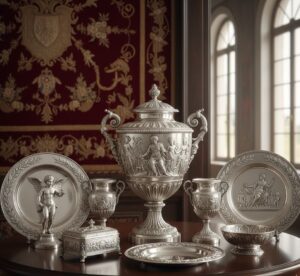
Mythological figures and classical symbolism have long influenced silver decorative arts.
In the Neoclassical period of the late 18th century, inspired by ancient Greece and Rome, motifs included:
- Greek gods and goddesses: Represent allegorical figures of power, wisdom and divine authority
- Laurel wreaths: A symbol of victory, glory, and high honour.
- Classical urns: Associated with mortality and memorialising the dead
- Cherubs and putti: Represent cupid-like, innocent figures often symbolising love
These elements reflected a fascination with antiquity. Silver from this era often features symmetrical compositions and restrained ornamentation, in contrast to the exuberance of Rococo.
- Geometric and Architectural Motifs
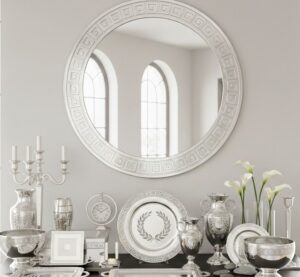
Not all silver decoration is organic. Many eras favoured structure and symmetry.
In the early Georgian period, silver often featured simple linear engraving and balanced proportions. The Neoclassical revival emphasised straight lines, fluting and symmetrical patterns inspired by architecture.
Then came Art Deco. Beginning in the 1920s, silver design shifted dramatically toward geometry.
Some common motifs:
- Greek Key (Meander): A continuous, interlocking line pattern used in borders.
- Swag and Wreath: Classical, Greco-Roman-inspired designs often found on antique silver, particularly in the 18th century.
- Geometric Shapes: Squares, rectangles, and circles, especially on modern minimalist or tribal-inspired silver items
- Cultural and Regional Motifs
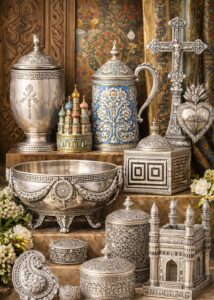
Silver motifs also vary by region and tradition.
In Scandinavian silver, especially from the late 19th and early 20th centuries, you often see restrained design with subtle engraving and folkloric elements.
In Russian silver of the 19th century, intricate enamel work combined with traditional Slavic patterns.
Spanish colonial silver frequently incorporates religious motifs, including crosses and sacred hearts, reflecting Catholic influence.
Indian silver often features dense surface decoration, intricate floral motif and geometric repetitions.
- Filigree/Jali Work: Delicate, lace-like, or trellis-work patterns, particularly famous in Cuttack (Odisha) and Karimnagar (Telangana).
- Paisley (Kairi): A teardrop-shaped motif with a curved upper end, commonly used in Indian textiles and jewellery.
- Architectural Motifs: Miniature replicas of monuments, such as the Charminar.
How Motifs Reflect Their Era
Motifs do not exist in isolation. They mirror broader artistic and cultural shifts.
- Baroque silver is bold and dramatic.
- Rococo silver is playful and asymmetrical.
- Neoclassical silver is balanced and restrained.
- Victorian silver is sentimental and detailed.
- Art Nouveau silver is flowing and organic.
- Art Deco silver is sleek and geometric.
Each period reacted to the one before it. Excess gave way to restraint. Ornament gave way to simplicity.
Understanding motifs allows collectors and enthusiasts to identify approximate dates and stylistic influences.
Motifs Then and Now
While antique and vintage silver pieces carry historical motifs, modern silversmiths still draw from these traditions.
Floral patterns remain popular in flatware and decorative trays. Animal forms still appear as sculptural handles or finials. Geometric borders inspired by Art Deco are common in contemporary barware and tableware.
However, modern design often blends eras. You might find a minimalist bowl with subtle botanical engraving, or a classical laurel wreath rendered in a clean, modern style.
Final Thoughts
Antique and vintage silver decorative arts are defined as much by their motifs as by their forms. From curling acanthus leaves to sharp Art Deco lines, these patterns trace the evolution of taste across centuries
Motifs serve as the fingerprints of history. They reveal what people valued, admired, and aspired to at the time a piece was made.
The next time you hold an antique silver object, pause. Look closely at its surface. The story is there, etched into the metal, waiting to be read.


About Post Author