
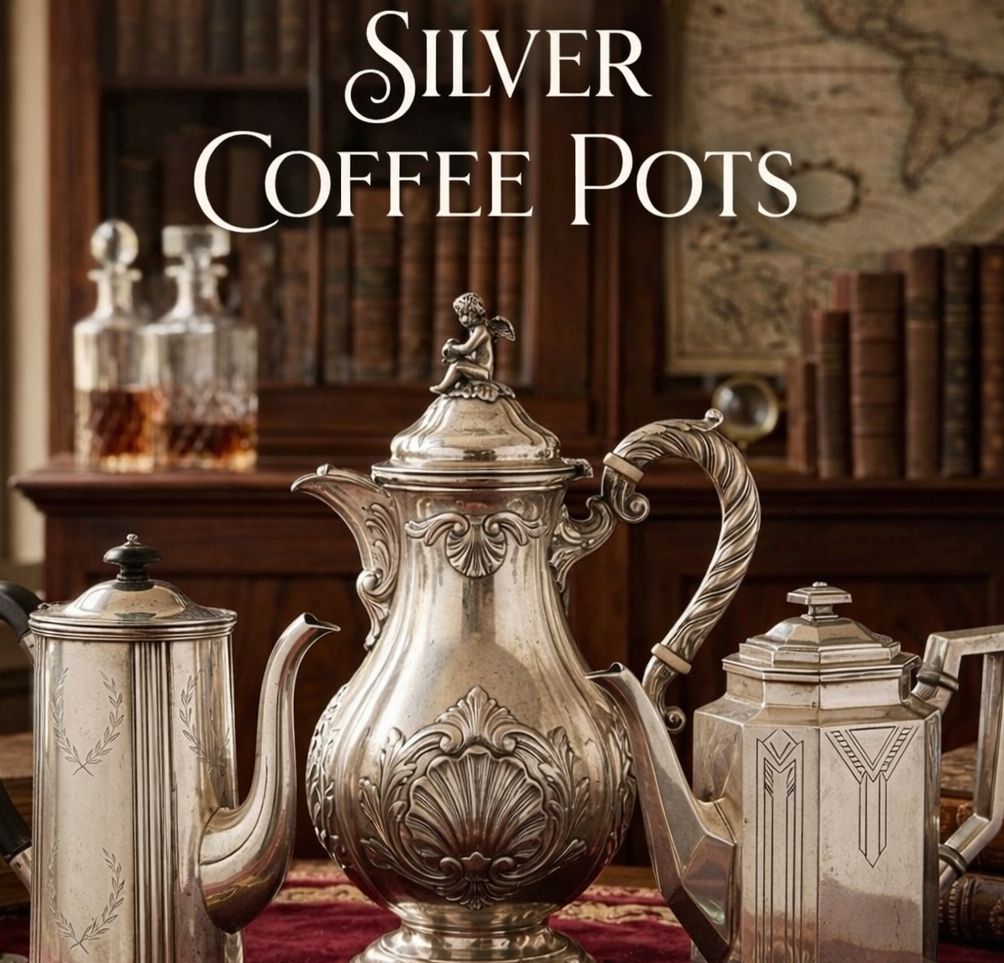
The Art of Coffee: Antique Silver Coffee Pots Through the Ages
Imagine this: It’s 1682, England. Before the whir of the electric grinder and the satisfying hiss of the espresso machine became commonplace, brewing coffee was a far more tactile affair. Roasted beans, ground by hand, tossed into a silver coffee pot, then doused with hot water. It was a process remarkably akin to making tea today, a gentle infusion where patience was as key an ingredient as coffee beans.
Looking back, especially through the lens of antique collections, you see just how central these pots were to domestic life. From the early 1700s right up to the cusp of the 20th century, these coffee pots were crafted from precious silver and by esteemed ceramic houses like Wedgwood and Royal Worcester.
Antique and vintage silver coffee pots tell stories about the past. From elaborate royal households to refined Victorian tea rooms, these objects once played an important role in social life. Today, these antique silver coffee pots are valued by collectors, interior designers, and coffee lovers who appreciate both their beauty and their historical significance.
In this article, we will explore the history of silver coffee pots, their origins, the evolution of their styles, and the different types that emerged over time.
Also Read: Popular Silver Motifs in Decorative Arts
The Origins of Coffee and the History of Silver Coffee Pots
The history of coffee drinking began in the Middle East around the 15th century. The drink spread from Ethiopia to Yemen and then across the Ottoman Empire.
European aristocrats quickly adopted coffee as a fashionable drink. With this popularity came the demand for elegant serving ware.
Coffee has been a favourite drink in the UK since it was brought here during the 16th Century. Silver coffee pots were first recorded at the St. Germain’s fair in Paris in 1672, and since then have been produced by English silversmiths in various designs and forms.
Evolution of Silver Coffee Pots
As coffee culture spread across Europe and beyond, silversmiths adapted their designs to match the artistic movements of each era while improving functionality and elegance.
-
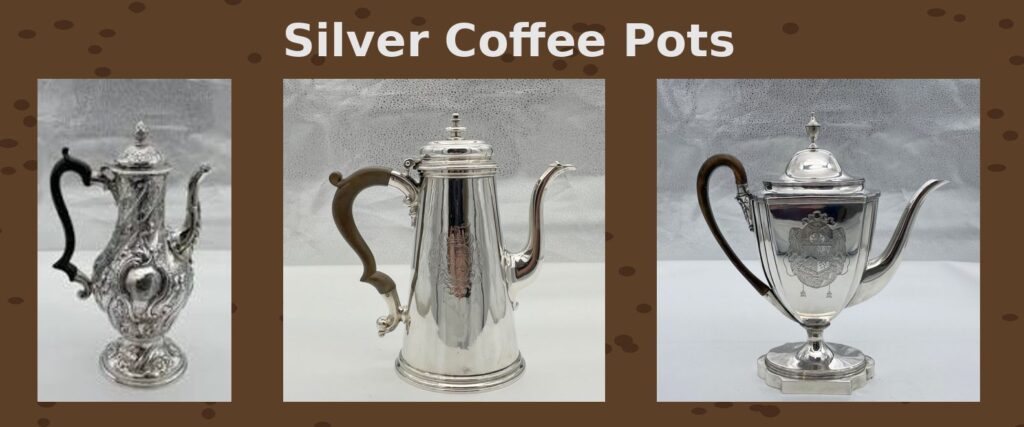
1690s–1710s: Conical and Tapering Forms
The earliest European silver coffee pots appeared in the late 17th century, shortly after coffee became fashionable in England and other parts of Europe.
Design: These early designs were tall, slender, and strongly tapered, often resembling a cone. The narrow shape helped keep coffee grounds at the bottom while pouring. Handles were commonly made of wood or sometimes ivory so the user could hold the pot without being burned.
Decoration: Decoration was generally restrained, with smooth surfaces and simple engraved details. Functionality and elegance were the main focus of these early forms.
-
1720s–1750s: Queen Anne and Rococo Influence
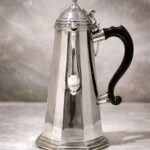
Under the influence of the Queen Anne and Rococo periods, shapes began to change from strict cones to more sculptural forms.
Design: Coffee pots from this era were often:
- Octagonal in cross-section
- Pear-shaped or bulbous
- Sometimes described as “lighthouse-shaped”
Decoration: These silver coffee pots typically had polished surfaces with subtle engraving rather than heavy ornamentation.
-
1760s–1780s: Neoclassical and Urn-Shaped Designs
By the mid-18th century, the Neoclassical movement began influencing decorative arts across Europe. Inspired by ancient Greek and Roman forms, silversmiths adopted more symmetrical and architectural designs.
Design: Coffee pots from this period often took on an urn-like shape, standing on small pedestal feet with straight or gently tapering sides.
Common features included:
- Urn-shaped bodies
- Pedestal bases or small feet
- Straight, tapered profiles
Decoration: These coffee pots sport classical decorative motifs such as garlands or medallions.
-
19th Century: Victorian and Melon Forms
The 19th century brought significant changes in both technology and taste
Design: Victorian coffee pots often became more ornate and decorative. The melon style, characterized by rounded vertical lobes around the pot’s body, was particularly popular. Not to mention, these designs added depth and texture to the surface, that helped showcase not only the skill but also the artistry of the silversmith.
Decoration:
Typical Victorian features included:
- Elaborate chased patterns
- Acanthus leaf and floral motifs
- Decorative finials on hinged lids
- Engraved monograms or crests
-
Early 20th Century: Art Deco and Modern Forms
As the 20th century began, decorative tastes shifted toward modern simplicity.
Design: By the 1920s and 1930s, the Art Deco movement dramatically changed the appearance of silver coffee pots. Instead of ornate engraving and historical motifs, designers embraced clean lines, geometry, and streamlined shapes.
Decoration:
Art Deco coffee pots often featured:
- Angular or cylindrical forms
- Strong geometric patterns
- Smooth, polished surfaces
- Minimal ornamentation
Many examples from this era were produced in Sheffield plate or sterling silver and reflected the influence of modern industrial design.
Types of Antique and Vintage Silver Coffee Pots
Antique and vintage silver coffee pots can be categorized by their material, form, and the way they were used in traditional coffee service.
-
Georgian Coffee Pots
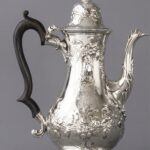
Georgian silver coffee pots were produced in Britain between 1714 and 1830.
Key characteristics include:
- Pear-shaped bodies
- Wooden handles
- Long spouts
- Elegant engraved decoration
-
Victorian Coffee Pots
Victorian coffee pots often feature elaborate embossing and decorative motifs. They were commonly produced by well-known silver manufacturers.
They typically have:
- Tall shapes
- Decorative lids
- Ornate engraving
- Heavy construction
-
The Melon Coffee Pot
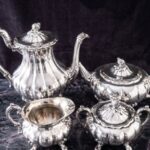
One of the most distinctive designs from the 19th century is the melon-shaped coffee pot. This style became especially popular during the reign of William IV and the early Victorian period.
The melon pot is easily recognized by its rounded, bulbous body that is divided into vertical lobes or ribs, resembling the surface of a melon. Moreover, these ribbed sections create depth and texture, allowing light to reflect beautifully off the silver surface.
-
The Urn Form Coffee Pot
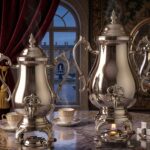
Another important historical design is the urn-shaped coffee pot, which emerged during the late 18th century under the influence of the Neoclassical movement.
Inspired by classical Greek and Roman vessels, urn-form coffee pots typically feature a straight, tapered body that widens slightly toward the middle before narrowing again at the top.
-
Coffee Service Pots
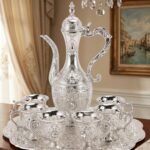
By the 19th century, silver coffee pots were rarely sold as single pieces. Instead, they were usually part of a complete tea and coffee service designed for formal entertaining.
A traditional coffee service set often included:
- A coffee pot
- A teapot
- A sugar bowl
- A milk or cream jug
Larger and more elaborate services might also include items such as hot water kettles, serving trays, waste bowls, and additional creamers.
Final Thoughts
Antique and vintage silver coffee pots are more than decorative objects. They reflect centuries of design, craftsmanship, and social tradition.
From the elaborate Baroque coffee pots of the 17th century to the sleek Art Deco designs of the 20th century, these pieces show how everyday objects evolve with changing tastes and technologies.
For collectors and coffee enthusiasts alike, a silver coffee pot is a reminder of a time when even simple rituals like serving coffee were elevated into an art form.
Giftex: A World of Collectibles Auction
Giftex is proud to present its latest “A World of Collectibles” Auction this March. From rare antique treasures to exquisite silver collectibles, this event brings together a remarkable selection of historic and decorative pieces for collectors and enthusiasts alike. Whether you are an experienced collector or simply appreciate fine antiques, this event promises something special for everyone.


About Post Author