
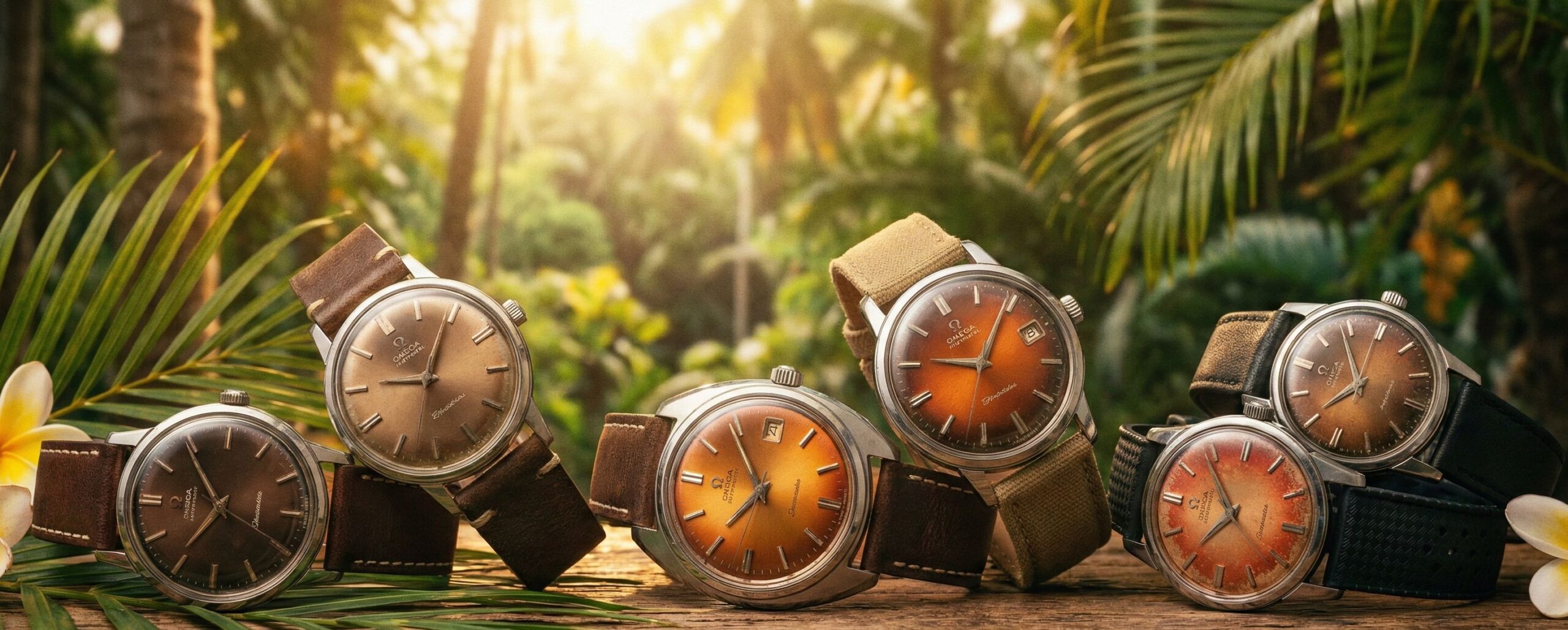
The Magic of Sun Kissed Timepieces: Tropical Dial Watches
For many, vintage watch collecting is special because every watch tells a story. This story is especially seen in vintage watch dials. It is rare to find a vintage piece that has lived a quiet life. Every scratch, every mark, every spot of patina carries a memory. Among all the elements of a vintage watch, few details inspire the kind of passion that a vintage watch dial does. This is the face of the watch. Within this world of dial-obsession, one category has captured global attention: the tropical dial.
Tropical dial watches are a unique and fascinating category of vintage timepieces that have captured the attention of collectors and enthusiasts alike. These tropical watch dials sit in a fascinating space where time, sunlight, and chemistry come together to create an effect that can never be repeated by modern manufacturing. These watches did not begin life with brown dials. They were once black, blue, or silver. Over decades of exposure to heat, humidity, and sunlight, these dials aged into warm shades of caramel, tobacco, and deep chocolate. For many, owning a tropical dial is the crowning jewel of a collection because these changes cannot be engineered. What was once considered a flaw has now become an object of beauty and prestige. To understand why these watches inspire such admiration, we need to look at what tropical dials are, how they form, and why they have become some of the most desirable vintage pieces on the market.
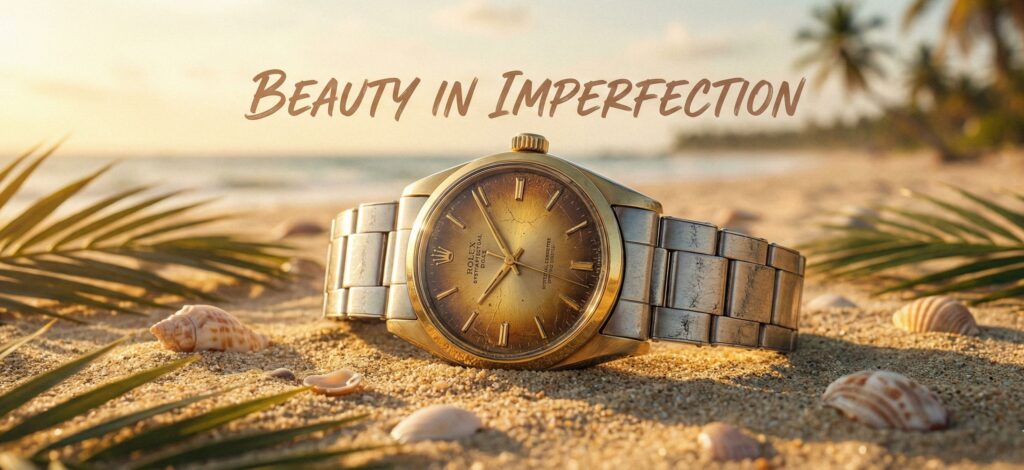
Learn More About Vintage Watch Dials Here
What Are Tropical Dial Watches?
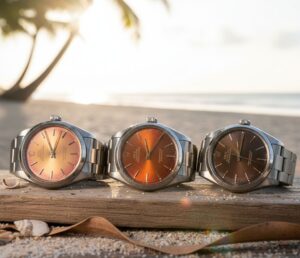
A tropical dial is a watch dial that has changed colour over many years due to environmental exposure, especially sunlight.
Over time, the paint begins to fade, revealing a warm brown tone. The final colour can fall anywhere on the spectrum from light honey to dark cocoa. Sometimes the shift also reveals hints of red, orange, or pink.
Collectors call this slow and natural colour change tropicalization. It is not just a fade. It is a transformation. The dial becomes something entirely new. Even two watches of the same reference from the same year will never age in the same way.
What makes tropical dials so special is the fact that the change happens organically. There is no intervention from the factory. No designer planned for these colours to appear.
A watch that lived its life in a drawer will never develop a tropical dial. A watch worn daily under the sun might.
The Science Behind the Change
To understand tropicalization, it helps to look at the materials used in mid-century watchmaking. Many dial makers used organic paints and lacquers that lacked strong ultraviolet protection.
When a watch with one of these dials spent years in strong sunlight, ultraviolet radiation began to break down the chemical compounds in the paint. The process is called oxidation. Add heat, humidity, and time, and the dial starts to shift from its original tone to a warm brown. The specific shade depends on the pigment used, the level of UV exposure, and the environment in which the watch lived. This explains why no two tropical dials are identical.
What Makes a Tropical Dial Appealing?

A genuine tropical dial has several traits that collectors look for:
- Rich brown colouration
This is the main draw. A dial that has shifted into a warm, even brown tone is highly prized. The best examples display a smooth and consistent gradient that shows the path of sunlight over decades.
- Natural, uneven ageing
The colour change often appears stronger at the outer edges of the dial, where the sun hits most directly.
- Attractive patina on markers and hands
Over time, the lume on hour markers and hands also ages. Instead of pure white, it may turn cream, yellow, or even a soft pumpkin tone.
- Character and uniqueness
Even among tropical dials, the best examples stand apart. Some have smooth chocolate tones. Others have a reddish glow.
From Flaw to Collector Obsession: The Rolex Tropical Dials
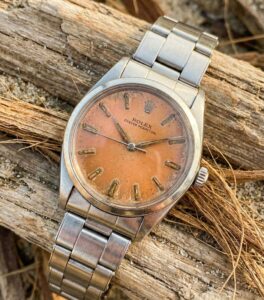
Rolex collectors, in particular, have played a large role in popularising tropical dials. For most of its history, Rolex focused on precision and durability.
That is why any unexpected outcome, especially one that affects aesthetics, becomes a point of fascination.
Vintage Rolex models like the Submariner, GMT-Master, and Daytona can command enormous premiums when they feature well-preserved tropical dials.
What was once seen as a defect is now considered desirable because it signals authenticity, age, and rarity.
Beyond Rolex: Omega, Patek Philippe, Audemars Piguet
The tropical phenomenon is not limited to Rolex. Many brands from the mid-1900s used similar dial materials, which means tropical dials appear across the vintage landscape.
Omega Speedmasters with chocolate dials are sought after by collectors who love the space heritage of the watch and the warmth added by tropicalization. Certain Patek Philippe references have aged into stunning shades that combine elegance with character. Early Audemars Piguet pieces, especially those from the 1950s and 60s, also produced tropical dials that now stand out in the high-end vintage market.
No matter the brand, a tropical dial adds personality. It gives a watch a life story.
Not All Tropical Dials Are Created Equal
Collectability comes from quality. This is where buyers must be careful. While a beautifully aged tropical dial can command a premium, not every discoloured dial is desirable.
A strong tropical dial should show:
- even ageing
- smooth colour tone
- natural transition across the dial
- attractive patina
What collectors avoid are dials that look blotchy, stained, or damaged by moisture. These often have spots, streaks, or mould-like patterns that suggest water intrusion rather than sun exposure. Such pieces may still have charm, but they do not carry the same value.
Why Collect Tropical Dial Watches?
Collectors fall in love with tropical dials for several reasons.
- They are rare and organic
A true tropical dial is the result of nature and time. You cannot order one, request one, or manufacture one today.
- Each one is unique
Two tropical dials from the same brand, model, and year will still age differently. This gives collectors a sense of owning something personal.
- They reflect craftsmanship and endurance
These watches have survived decades of wear and weather. Their ageing does not weaken them.
- They have strong market value
Collectors pay significant premiums for well-preserved tropical dials.
- They tell a story
A tropical dial is a visual diary. It shows how the watch lived, who wore it, and where it travelled.
Conclusion
Tropical dial watches are a perfect example of how time can transform a flaw into something beautiful. They carry the spirit of adventure and the marks of a long life lived under the sun. These watches remind us that perfection is not always the goal. Sometimes character, history, and natural ageing create something far more compelling.
For collectors, a tropical dial is more than a colour shift. It is a story captured on a watch face. A record of decades. A fusion of craft and nature. A reminder that true beauty often appears where no one planned for it.


About Post Author