
When Diamonds Turn Deadly: Curse of the Hope Diamond and Other Cursed Gems
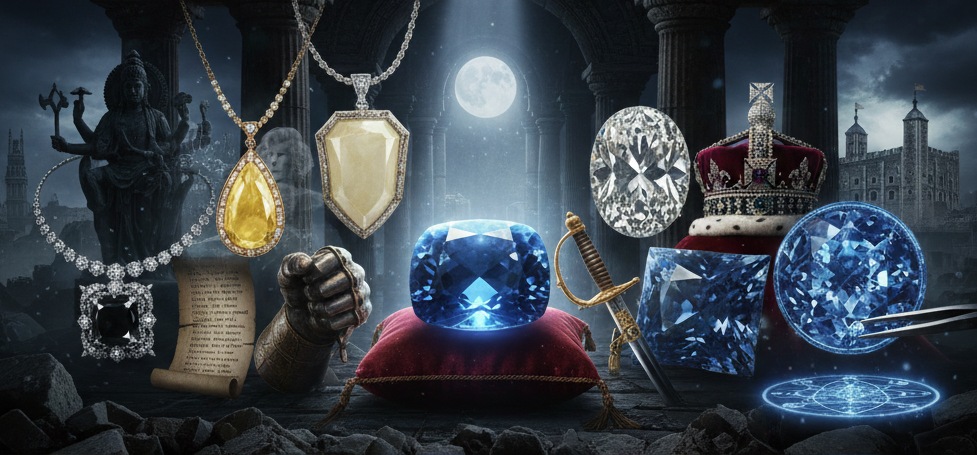
Diamonds catch the eye the way lights twinkle in the night. They shine with a kind of confidence that feels almost supernatural. For centuries, people have worn them as symbols of love, power, wealth, and beauty. Yet not every gem brings comfort. Some of the world’s most famous diamonds carry stories far darker than their brilliant spark. The stories of famous cursed diamonds read like Greek tragedies. Today, we take a journey through history and myth, exploring the captivating stories behind the most infamous cursed diamonds. From the famous curse of the Hope Diamond, the Koh-I-Noor, the Black Orlov, and several others that continue to raise questions about whether curses are real, or if coincidence can sometimes look a little too planned.
Where the Curse Begins: Belief, Mystery, and Fear
Before we embark on this fascinating exploration, it’s worth considering how the whispers of a “curse” might originate. Are they merely a series of unfortunate accidents, a tapestry woven from coincidence and human hubris? Or is there a deeper, perhaps supernatural, effect at play – a cosmic retribution for touching what should not be touched? Many origins of these curses are rooted in ancient beliefs: some are believed to be the wrath of gods, invoked when sacred gems are taken from places of devotion. Other gemstones are simply believed to be inherently evil, destined to bring bad luck to their owners. Some, like the legendary Koh-i-Noor, come with specific conditions attached, proclaiming that they can only be worn by gods or women, lest their male owners face a grim fate.

Also Read: A Queen’s Gem: The Marie-Thérèse Pink Diamond
Famous Cursed Diamonds: A Trail of Glittering Misfortune

Here, we present some of the most renowned diamonds whispered to carry a curse:
- The Hope Diamond: A Beauty with a Dark Shadow

The Hope Diamond, one of the most famous gems in the world, is renowned for its striking blue colour and storied past.
Hardly any other gemstone attracts as many legends, myths and speculations as the Hope Diamond. This deep blue, 45.52-carat beauty is one of the most famous cursed gems in history.
The dark history of the Hope Diamond includes a long list of misfortunes:
- Jean-Baptiste Tavernier, the French merchant who first brought the stone to Europe, was supposedly torn apart by wild dogs.
- King Louis XVI and Marie Antoinette, who owned the diamond, both met their fate at the guillotine during the French Revolution.
- Henry Philip Hope, from whom the diamond got its name, suffered financial ruin, and subsequent owners experienced similar economic disasters.
- Evalyn Walsh McLean, a wealthy socialite who adored the diamond, endured unimaginable personal tragedies, including the deaths of her son and daughter and the collapse of her family’s fortune.
Today, the Hope Diamond resides in the Smithsonian National Museum of Natural History, a silent testament to its dramatic past, keeping its curse contained behind a glass display.
- The Black Orlov: The Eye of Brahma’s Curse

The Black Orlov was a cursed diamond from the start. The original 195-carat black diamond was once the eye of a 19th-century Hindu statue of Brahma, and the monk who stole the stone from the statue was murdered. In the early 1900s, several owners died by suicide under disturbing circumstances. Rather bizarrely, two Russian royals owned the diamond, and separately, both jumped to their deaths. In an attempt to break the curse, one owner had the diamond cut into smaller pieces. After that, the tragedies seemed to slow down, but the mystique remains.
- The Koh-I-Noor Diamond: A Gem of Power and Peril
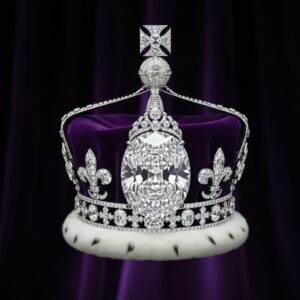
The Koh-I-Noor diamond is perhaps the most politically charged and historically significant diamond on this list. Its curse is explicitly documented in an ancient Hindu text dating back to 1306, which warns:
“He who owns this diamond will own the world, but will also know all its misfortunes. Only God, or a woman, can wear it with impunity.”
It passed through the hands of various Hindu, Mongolian, Persian, Afghan, and Sikh rulers, and virtually every male prince or emperor who possessed it ultimately lost his power, if not his life, in brutal conflicts and coups.
Historical records indicate the diamond was acquired by the British in 1849 and given to Queen Victoria in 1850. To heed its legend, the diamond has since only been worn by women.
- The Cursed Blue Moon Diamond: A Precious Gem with a Dark Side
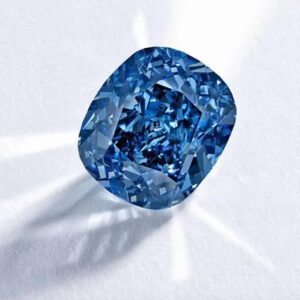
While the Hope Diamond is the most famous blue diamond, the story of the Blue Moon Diamond, now renamed the Blue Moon of Josephine, also touches upon the theme of misfortune. Its discovery brought excitement, but almost immediately, financial troubles and disputes followed its early owners. A series of accidents linked to the gem kept the rumour of a curse alive.
- The Regent Diamond: A Curse of Betrayal and Revolution
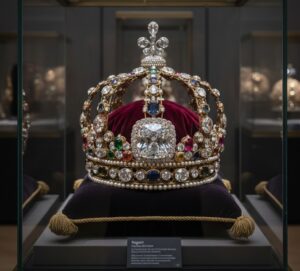
The Regent diamond had a macabre start, like many other cursed diamonds. In the 18th century, an Indian slave discovered the stone and carried it away in a self-inflicted leg wound. An English commodore who promised to help him smuggle the cursed diamond out of India instead murdered him and took the stone.
It appeared as a centrepiece of the French Crown Jewels and seemed to usher in misfortune for its royal owners. Louis XVI and Marie Antoinette, who both wore the diamond, were famously decapitated during the French Revolution. The diamond then resurfaced on Napoleon I’s sword. The curse followed the emperor: After he lost the Battle of Waterloo, he was exiled and isolated.
Intriguingly, the Regent Diamond was one of the few pieces of the French Crown Jewels, was left untouched during a recent Louvre heist. It can be speculated that the thieves, aware of its long and dramatic history, feared adding the burden of the “cursed” diamond to their haul.
Also Read: Unveiling The Mystery Of The Louvre Heist
- The Sancy Diamond: A Legacy of Loss

The Sancy’s gruesome history as one of the most iconic cursed diamonds dates to the 16th century.
The diamond has been linked to betrayals, assassinations, and royal misfortunes across Europe. At one point, a messenger carrying it swallowed the gem to protect it, only to be killed shortly after. The diamond was recovered in a grim way.
Today, the Sancy rests in the Louvre beside the Regent, separated from the chaos of its past. Its pale yellow glow gives little hint of the trouble it once caused.
- The Moon of Baroda: Beauty Tied to Bad Luck

The Moon of Baroda is a stunning 24.04-carat canary yellow, pear-shaped diamond. Its unique curse is tied not to the act of theft, but to geography.
The story goes if the Moon of Baroda diamond crosses the sea or ocean, it will bring bad luck to its owner. For nearly 500 years, the diamond remained in the possession of the powerful Gaekwad Maharajas of Baroda, India. Its first recorded journey across the sea was in the mid-1700s when it was sent to Empress Marie Thérèse of Austria. Coincidentally or not, the Empress died shortly after. The diamond was then sold and made its way to America in the 1940s, crossing the Atlantic.
In 1953, the diamond gained international fame when it was loaned to Hollywood icon Marilyn Monroe, who wore it while singing “Diamonds Are a Girl’s Best Friend”. While the exposure was spectacular, the following years saw Monroe’s personal and professional life spiral downwards.
Fact or Fiction? The Mystery Behind Cursed Diamonds
Stories of cursed gems catch our attention because they touch a corner of the imagination that wonders what power beauty might hide. Are the curses real? Maybe not in the supernatural sense. Some tragedies may be coincidental, others the result of greed, theft, or political turmoil.
Still, the belief in a curse gives these diamonds a character that simple brilliance cannot match. Their legends survive because they remind us that luxury has a price, and beauty can carry a history deeper than the surface suggests. Would you tempt fate and wear one of these magnificent, tragic jewels?


About Post Author