

Where Function Meets Elegance: The Story Of the Sports Watch
Imagine this! It’s the late 1930s, edging into the 1940s, and watchmakers are starting to question an old assumption. Why should fine watches only belong in boardrooms, dinner jackets, and quiet offices? Why shouldn’t a beautifully made watch also belong on a wrist that swims, flies, drives, dives, or explores? Why should watches be only for boardrooms and formal affairs? Why not for those who crave adventure beyond the four walls?
This audacious thought gave rise to the luxury sports watch we are all so familiar with today.
The main thought behind a luxury sports watch was the combination of utility and elegance, without compromising on style, of course!
Why should a high utility watch just be for telling time and looking good? Why can’t it embrace the soul of an adventurer and enter into the realm of water resistance, shock resistance and robust design, capable of handling any stress?
Born out of these unwavering thoughts, the luxury sports watch holds a very special place in every watch collector’s heart.
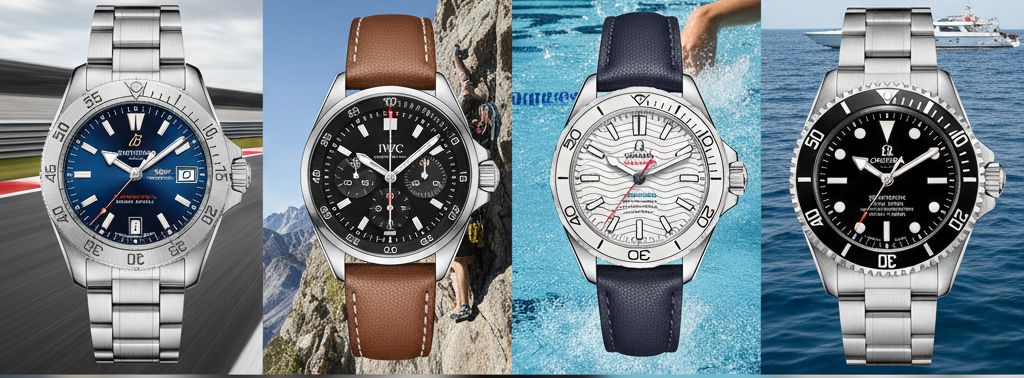
From the Rolex Submariner to the TAG Heuer Monaco, from the Breitling Navitimer to an Omega Speedmaster, and of course, the Audemars Piguet Royal Oak, these are some of the world’s finest vintage sports watch brands that have captivated the horological world.
Explore the breathtaking journey of luxury sports watches from their revolutionary emergence in as early as the 1930s to their enduring legacy today. Discover iconic vintage sport watch models that stand for sophistication, innovation, and timeless style.
Also Read: Allure of Vintage Watches
What Is a Sports Watch?

At its core, a sports watch is a tool designed for activity. Unlike traditional dress watches, sports watches were made to withstand physical stress while remaining legible and reliable.
Key traits include:
- Water resistance
- Shock resistance
- Strong, sealed cases
- Clear, high-contrast dials
- Robust movements designed for regular use
What makes a luxury sports watch different is the level of execution. These watches weren’t just practical. They were finely finished, thoughtfully designed, and made by brands with deep watchmaking expertise. They were tools, yes, but tools made beautifully.
These watches were built to solve real problems for pilots, divers, drivers, and professionals who depended on them.
Origin of Luxury Sports Watches
The origins of the luxury sports watch stretch back further than many people realise. As early as the 1930s, brands were experimenting with waterproof cases, anti-magnetic movements, and shock protection.
Rolex’s Oyster case, introduced in 1926, proved that a wristwatch could be genuinely water-resistant. By the 1930s and 1940s, this technology began to influence everyday watches, not just niche experiments.
World War II also played a major role. Military-issued watches demanded durability, legibility, and reliability under extreme conditions. After the war, those expectations didn’t disappear. Instead, they followed soldiers, pilots, and engineers back into civilian life.
The post-war period created a new kind of customer. Someone who wanted a watch that could handle weekends outdoors and weekdays in the city. That customer didn’t want to switch watches for every situation. They wanted one watch that did it all.
A Look at the Evolution of Sports Watches
The evolution of the sports watch did not happen overnight. It unfolded gradually, driven by real-world needs: protection from the elements, reliability under stress, and legibility in extreme conditions.
- 1926: Rolex Oyster – The First Waterproof Wristwatch
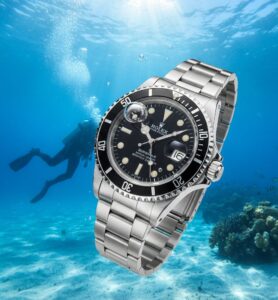
In 1926, Rolex introduced a breakthrough that would permanently change wristwatch design. The Rolex Oyster became the world’s first waterproof and dustproof wristwatch, thanks to its hermetically sealed case.
- 1936: IWC Special Pilot’s Watch – Designed for the Skies
As aviation advanced, pilots needed reliable instruments they could depend on in unheated cockpits at high altitudes. In 1936, IWC responded with one of the first wristwatches purpose-built for pilots.
- Late 1930s: Breitling Huit Aviation Chronographs – Precision Under Pressure
Breitling further refined aviation timekeeping with its Huit Aviation Department chronographs. Used extensively during World War II, including by the Royal Air Force, these chronographs cemented the idea that wristwatches could be mission-critical tools rather than simple timekeepers.
- 1952: Breitling Navitimer – The Golden Age of Aviation
The post-war boom in commercial aviation brought with it one of the most iconic sports watches ever made: the Breitling Navitimer.
- Mid-1960s to Mid-1970s: The Space Age and Racing Chronograph Era
Few periods shaped sports watches more than the mid-1960s through the mid-1970s. Human ambition pushed beyond Earth, while motorsport captured global attention.
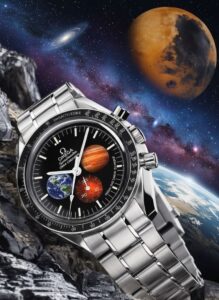
- The Omega Speedmaster emerged as one of the most significant watches in history. In 1969, it became the first watch worn on the Moon, earning its legendary status through performance, not marketing.

- 1963: Heuer Carrera – Timing at Speed: In 1963, Heuer introduced the Carrera, a chronograph designed specifically for professional drivers. Clean, legible, and functional, it embodied the spirit of endurance racing. Tag Heuer continued this momentum with bold designs like the Monaco, famously worn by Steve McQueen, reinforcing the brand’s deep connection to motor racing.
- 1971: Rolex Explorer II – Built for Extremes
In 1971, Rolex expanded its tool-watch lineup with the Oyster Perpetual Explorer II. Designed for spelunkers, polar explorers, and adventurers operating in complete darkness, the watch featured a fixed 24-hour bezel and an orange 24-hour hand to distinguish day from night.
- 1972: Audemars Piguet Royal Oak – Luxury Redefined
The launch of the Audemars Piguet Royal Oak in 1972 marked a turning point. Designed by Gérald Genta, it challenged traditional ideas of luxury.
Crafted in stainless steel, featuring an octagonal bezel with exposed screws and an integrated bracelet, the Royal Oak was bold and unapologetic.
- Late 1970s–1980s: The Quartz Crisis and the Fight for Relevance
The late 1970s and 1980s were a turbulent period for Swiss watchmaking. The rise of inexpensive, ultra-accurate quartz watches from Japan threatened the very existence of mechanical watchmaking.
In 1983, Casio introduced the G-Shock, a watch that redefined durability. While not a luxury watch, its influence on sports watch design was undeniable.
- 1990s: Mechanical Sports Watches Become Cultural Icon
By the 1990s, mechanical sports watches had survived the quartz crisis and emerged stronger. They were no longer judged solely on function. They carried emotional, cultural, and collectible value.
Allure of Vintage Sports Watches
Vintage luxury sports watches were made before marketing language caught up with them. They weren’t called “icons” when they were released. They earned that status over decades of use.
They also reflect a time when:
Watches were expected to last a lifetime. Repairs were normal, not failures. Scratches and wear were signs of use, not flaws.
Modern sports watches are impressive, but vintage examples often feel more human. Smaller cases, warmer materials, and simpler movements make them feel closer to the wrist and closer to their original purpose.
The Enduring Legacy
Vintage luxury sports watches represent a moment when watchmaking aligned perfectly with real life. They were born from practical needs, refined through innovation, and elevated through craftsmanship.
They remind us that luxury doesn’t have to be fragile, and utility doesn’t have to be dull. A great sports watch can do more than tell time. It can carry history, purpose, and character on the wrist
That’s why, decades later, collectors still chase these watches. Not because they’re trendy, but because they feel honest. Built to be used. Built to last.
And built at a time when adventure wasn’t a slogan, it was simply part of life.


About Post Author