When Clay Became Canvas: The Art of Painted Vases Across Cultures
Throughout art history, vases have played a significant role in both still-life paintings and as decorative elements within larger compositions.
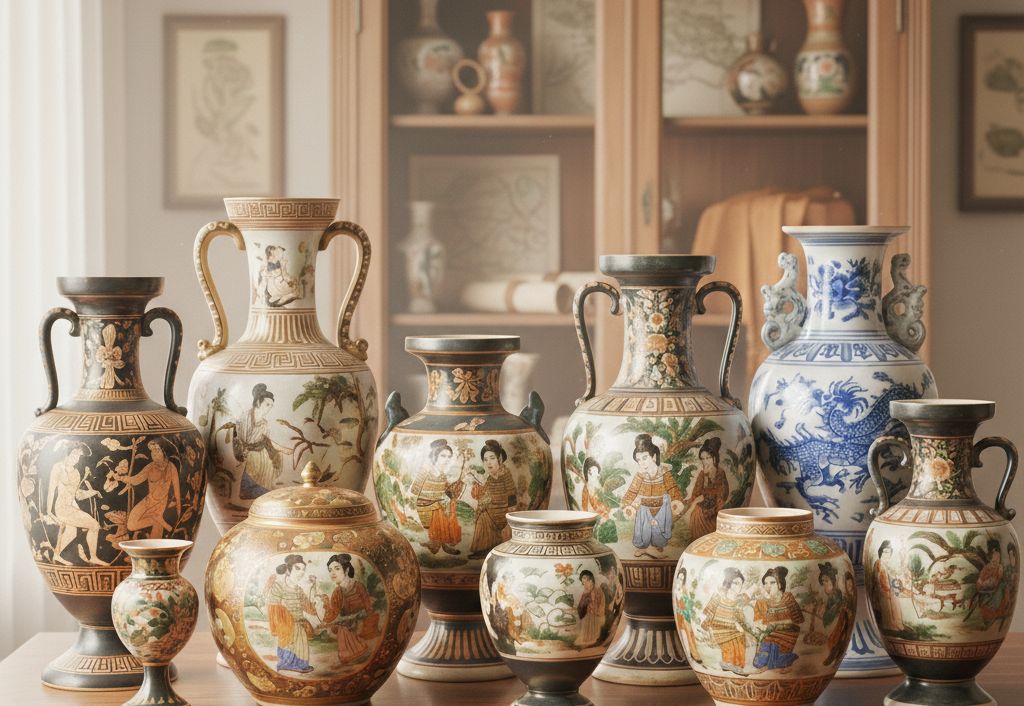
Vase painting history has evolved from simple prehistoric utilitarian markings to highly sophisticated, narrative-driven art forms. Across cultures, painting on vases became a way to record myths, honour nature, express faith and display refinement. Though made from the same humble material — clay — painted vases evolved into dramatically different art forms depending on where and when they were created. Each civilisation developed its own visual language, shaped by belief systems, materials and aesthetics.
Let us travel culture by culture, vase by vase and explore the antique painted vases from different civilisations.
Also Read: A Guide To Antique Porcelain Types
Where Vase Painting Began: Beauty Meets Daily Life
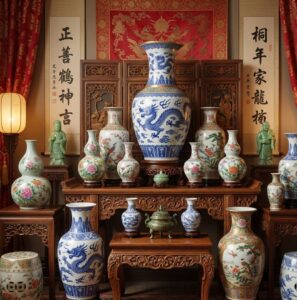
The earliest painted vases appeared wherever clay was abundant — the Mediterranean, the Middle East, China and parts of Asia. Unlike paintings created purely for display, vases lived with people. They were held, poured from, gifted, buried with the dead and used in rituals. Painting them was not decoration alone; it was storytelling woven into daily life.
As societies grew more complex, so did their ceramics. What started as simple lines and symbols soon became elaborate narratives, symbols of faith, status and identity.
Famous Painted Vase Styles By Civilisations
- Ancient Greece: The Birthplace of Narrative Vase Painting
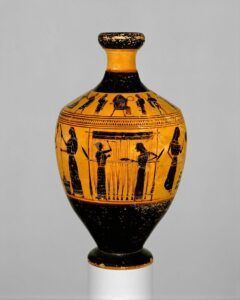
If vase painting had a golden beginning, it was in ancient Greece.
Greek potters turned vessels into storybooks. Heroes, gods and athletes appeared frozen mid-action — Achilles in battle, Dionysus at a feast, wrestlers locked in motion.
- Protogeometric: Following the Dark Ages, this style was characterised by simple, precise black bands, concentric circles, and wavy lines, often created using compasses and multiple brushes.
- Geometric: Defined by horror vacui (fear of empty space), this style filled vases with intricate, horizontal bands of patterns like meanders, triangles, and zigzags.
- Black-Figure Technique: Pioneered in Corinth and perfected in Athens, this method involved painting figures in black slip on natural red clay. Themes usually featured mythology and heroic deeds.
- Red-Figure Technique: Invented around 530 BCE, this technique reversed the process: the background was filled with black slip, leaving the figures in the natural red clay. This allowed for greater detail, perspective, and more naturalistic poses.
- White-Ground Technique: Used primarily for intimate, often religious or funerary vessels (lekythoi), this style involved applying a white clay slip, upon which figures were painted in polychrome (multiple colours), allowing for a more painterly, detailed effect.
- Ancient Rome: Elegance, Order and Adaptation
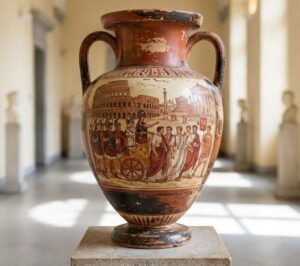
Roman vase painting inherited much from Greece but softened its drama. Roman ceramics often prioritised symmetry and decorative harmony rather than narrative intensity. Painting frequently appears as bands, panels or borders rather than full storytelling scenes.
Colours Used
- Earthy reds and browns
- Black and cream highlights
Motifs & Imagery
- Floral bands and garlands
- Architectural patterns
- Simplified mythological scenes
Roman vase painting focused more on elegance and utility than dramatic storytelling.
- Islamic Vase Painting: Geometry, Light and Divine Order
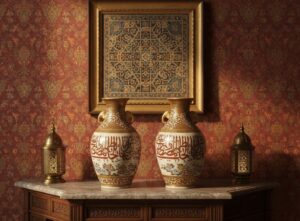
In the Islamic world, vase painting took a different path — one rooted in mathematics, spirituality and abstraction.
Rather than focusing on human figures, Islamic ceramics celebrated geometry, calligraphy and nature. Patterns repeat endlessly, suggesting infinity and divine order.
One of the most celebrated traditions is Iznik pottery, produced in Ottoman Turkey during the 16th century. Iznik vases are instantly recognisable for their luminous white ground and bold, confident brushwork.
Colours Used
- Cobalt blue
- Turquoise
- Emerald green
- Tomato red (Iznik)
- Gold and metallic lustre
Motifs & Imagery
- Stylised flowers
- Arabesques and vine scrolls
- Geometric patterns
- Calligraphy
- China: Porcelain, Poetry and Perfection
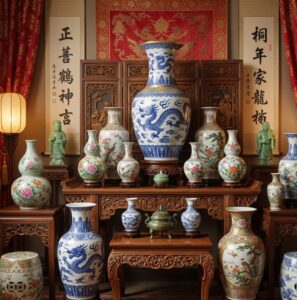
China didn’t just refine vase painting — it transformed it forever.
With the invention of true porcelain, Chinese potters created a smooth, luminous surface unlike anything the world had seen. This became the perfect canvas for painting.
Major Painting Styles
- Qinghua (Blue-and-White): Cobalt blue underglaze, a famous style from the Yuan/Ming dynasties, known for its clear lines and deep blue patterns on white porcelain.
- Youzhongcai (Between Glaze): Colours applied between glaze layers, offering delicate hues.
- Youshangcai (Above Glaze/Famille Verte/Rose): Painting over the glaze with vibrant, opaque enamels (greens, iron-reds, pinks, etc.), allowing for more complex, jewel-toned scenes, common in the Qing dynasty.
- Ink Wash (Shui-mo Hua): Monochromatic or light-coloured ink on paper/silk, focusing on atmosphere, depth, and the essence of nature (landscapes, bamboo).
Common Subject Genres
- Landscapes: Mountains, rivers, mist; conveying harmony between humanity and nature, a major genre since the Tang dynasty.
- Figures: Portraits, historical stories, religious scenes, and genre scenes (daily life).
- Birds-and-Flowers: Realistic depictions of flora and fauna, an independent genre by the 9th century.
- Japan: Elegance, Asymmetry and the Beauty of Imperfection
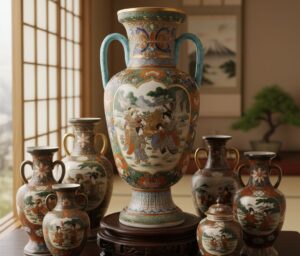
Japanese painted pottery is quieter, more poetic.
While early Japanese ceramics were rustic, later styles — influenced by Chinese imports — developed their own refined voice. Japanese artists embraced asymmetry, space and seasonal themes, reflecting the philosophy of wabi-sabi.
Major Painting Styles & Techniques on Vases
- Sumi-e (Ink Painting): Expressive, monochrome ink washes capturing the essence of nature, often mountains, bamboo, or blossoms, emphasising space and simplicity.
- Yamato-e & Nihonga: More detailed, colourful styles depicting court life, landscapes, and natural scenes.
- Ukiyo-e Influence: While famous in prints, its vibrant depictions of “floating world” life (actors, courtesans) sometimes appear on ceramics, especially later porcelain.
- Kakiemon Ware (Saga): Characterised by delicate, sparse designs in red, blue, green, and yellow, often featuring quail, flowers, or trees on white porcelain.
- Imari/Arita Ware: Famous for its rich cobalt blue underglaze with distinctive iron-red and gold overglaze, showing Chinese and European influences.
- Satsuma Ware: Features creamy crackled glaze with dense, intricate scenes, figures, and geometric patterns, often highlighted with gold.
Common Themes & Motifs
- Nature & Seasons: Cherry blossoms (Sakura), pine, plum, bamboo, chrysanthemums, birds (cranes, phoenixes), fish (koi).
- Landscapes & Mythology: Mountains, rivers, mythological figures, rural life.
- Geometric & Abstract: Repeating patterns, stylized clouds, wave motifs, or simpler, rustic textures (e.g., Bizen, Shigaraki).
- Everyday Life: Scenes from the court, tea ceremony, or common activities (influenced by Ukiyo-e).
- Europe (Renaissance & Beyond)
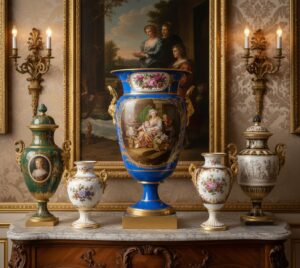
Famous Wares: Italian Maiolica, Dutch Delftware, French Faience
Art Style on Vases
European painted ceramics often imitate Chinese and Islamic models but adapt them to local tastes. Scenes are pictorial, framed like paintings.
Colours Used
- Blue and white
- Yellow, orange, green
Motifs & Imagery
- Biblical stories
- Mythology
- Floral garlands
- Pastoral landscapes
These wares brought painted ceramics into European homes.
What Unites These Traditions?
Across cultures and centuries, vase painting styles share some universal themes:
- Narrative storytelling: Myth, history and everyday life translated onto curved surfaces.
- Symbolic motifs: Plants, animals, deities and abstract geometry reflect cultural values.
- Colour theory: Contrast, harmony and symbolism shape the palette — from Greek black and red to Islamic blues and Chinese underglaze.
- Technical mastery: From slip painting and underglaze decoration to lustre and overglaze enamels, each tradition devised its own innovations.
Final Thoughts
Vase painting is much more than decoration — it is a form of visual storytelling, a cross-cultural dialogue, and a record of human creativity. Whether the stark heroes on an Attic amphora, the swirling arabesques of Iznik, the luminous blue of Chinese porcelain, or the refined elegance of Japanese Imari, these painted wares reflect the spirit and aesthetics of their makers.


About Post Author