
The Art of Dating Furniture: What Every Buyer Should Know
When you first start looking at antique furniture, it can feel like trying to learn a whole new language. There are so many periods, design styles and subtle variations that it is easy to get overwhelmed.
Spotting genuine antique and vintage furniture among reproduction pieces and cleverly disguised knockoffs has become something of an art form. Antique wooden furniture, especially in pristine condition, is increasingly rare and thus priceless. An antique piece of wooden furniture is valued not only for its age but also for its ornate carvings or charming motifs that set it apart from contemporary design. Learning to identify genuine antique and vintage furniture helps you avoid overpaying and discover valuable treasures others might overlook.
Whether you’re furnishing your home with character-filled pieces or looking to resell valuable finds, this guide will equip you with expert techniques to identify antique furniture.
Also Read: Antique Furniture Trends 2026
Identify Authentic Antique Furniture
https://www.youtube.com/watch?v=w8z378372Tc
Video credit: 320 Workshops
Let’s make this into a fun game. Think of yourself as a detective and put on your thinking hat. In order to identify authentic vintage and antique furniture, your first step is an overall visual examination. What is the piece of furniture you are identifying, its general shape, the style of the legs, and the materials used? A furniture piece’s curves, lines, and even the type of wood it’s made from tell its story, helping you distinguish a Victorian chair from an Art Deco table.
Here are some easy steps that can help you identify antique furniture:
- Understand the Difference Between Antique and Vintage
Before diving into authentication techniques, you need to know what qualifies as antique and what qualifies as vintage.
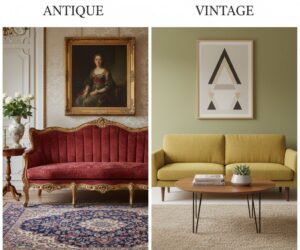
Antique furniture must be at least 100 years old. That means in 2026, a piece must have been made in 1926 or earlier to be considered an antique.
Vintage furniture, on the other hand, is typically 20 to 99 years old. These pieces reflect the design trends of a particular era but don’t meet the 100-year mark.
Understanding this age distinction immediately helps you narrow down possibilities. A sleek 1970s sideboard may be valuable and collectible, but it’s vintage, not antique.
- Know and Understand Different Historical Periods
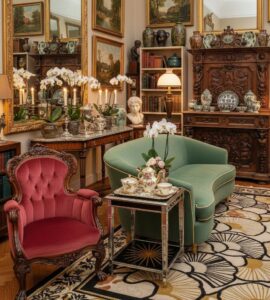
Antique furniture falls into specific historical design periods. Each era had its own materials, shapes, and decorative themes.
Some key periods include:
- Victorian (1837–1901) – Ornate, dramatic, and decorative
- Arts and Crafts (1895–1915) – Simple, handcrafted, solid wood focus
- Art Nouveau (1890–1910) – Flowing lines inspired by nature
- Art Deco (1920–1935) – Bold, geometric, symmetrical designs
For example:
- Victorian furniture often features dark woods like mahogany, heavy carving, and curved cabriole legs.
- Arts and Crafts pieces are more restrained, showcasing straight lines, exposed joinery, and oak wood.
- Art Deco furniture stands out with streamlined silhouettes, mirrored surfaces, bold contrast, and geometric patterns.
- Look at the Silhouette of the Furniture

The overall shape of a piece tells you a lot before you even inspect the details.
Ask yourself:
- Is it ornate with curves and scrollwork?
- Or is it clean, sharp, and geometric?
For instance, Victorian-era furniture often appears dramatic and curved, with carved backs and rounded edges. In contrast, Art Deco furniture is bold, symmetrical, and streamlined. The difference is immediately visible.
Pro tip: Don’t just look. Feel the piece. Run your hand along the surface. Older pieces often have slight irregularities from hand tools, while modern reproductions feel perfectly smooth and uniform.
- Identify the Wood
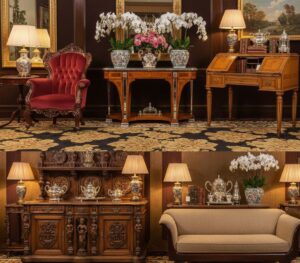
With over 60,000 tree species worldwide, wood identification can be complex, but you can narrow it down by understanding the basics.
Hardwood vs. Softwood
- Hardwoods (oak, mahogany, walnut, maple) were commonly used in high-quality antique furniture.
- Softwoods (pine, cedar) were often used in secondary areas like drawer interiors or backs.
How to Identify Wood
Grain pattern:
Oak has prominent, open grain. Mahogany has a finer, straighter grain. Walnut shows rich, wavy grain patterns.
Colour variation:
Mahogany ranges from reddish-brown to deep brown. Oak is lighter, often golden. Walnut tends to be darker and richer.
Hardness:
Hardwoods feel heavier and denser. Softwoods dent more easily.
- Look at Dovetailing and Imperfections
One of the clearest signs of antique craftsmanship is dovetail joinery.
What is dovetailing?
It’s a woodworking technique used to join two pieces of wood together, commonly seen in drawers. The joints interlock in a fan-shaped pattern that resembles a dove’s tail.
How to Identify Antique Dovetails
- Hand-cut dovetails (pre-1860) are uneven and slightly irregular.
- Machine-cut dovetails (post-1860) are more uniform and symmetrical.
- Perfectly identical joints often indicate modern production.
- Avoid Staples and Particle Board
Modern materials are immediate red flags.
If you see:
- Staples
- Phillips-head screws
- Particle board
- MDF
- Plywood with visible layered edges
You’re likely looking at a reproduction or modern piece.
- The Language of Carvings and Motifs
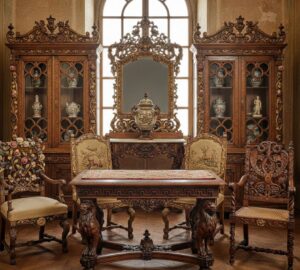
Carvings can act like timestamps. Certain decorative elements are strongly linked to specific periods.
Here are a few motifs to recognise:
- Greek Key:
A repeating geometric border pattern common in neoclassical designs.
- Acanthus leaves:
A classical decorative leaf motif often found in Victorian and earlier European styles.
- Floral and vine carvings:
Common in Art Nouveau pieces.
Learning to recognise motifs can help you quickly place furniture in the correct historical period.
Also Read: Understanding Motifs in Decorative Arts
- Leg Styles Matter
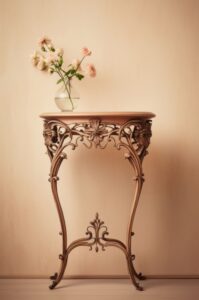
Furniture legs often reveal the era.
Some common styles include:
- Cabriole legs – Curved legs common in Queen Anne and Victorian pieces
- Straight square legs – Popular in Arts and Crafts furniture
- Fluted legs – Vertical grooves inspired by classical Greek columns
- Tapered legs – Frequently seen in mid-century modern furniture
- Turned legs – Rounded, spindle-style legs common in traditional pieces
- Decoding Inlay and Veneer Work
Inlay and veneer aren’t just decorative. They reveal craftsmanship level and origin.
Inlay involves embedding contrasting materials into the surface. These may include different wood species, mother-of-pearl, or ivory.
Veneer involves applying thin slices of decorative wood onto a solid base. Many 18th and 19th-century antiques used veneer to showcase exotic woods.
Be cautious: modern furniture also uses veneer, but antique veneer is typically thicker and shows natural ageing.
- Double Check Stamps, Labels, or Tags
Always inspect hidden areas:
- Inside drawers
- Back panels
- Underside of tables
- Bottom edges
Manufacturers often included stamps or labels that indicate origin and sometimes date.
How to Spot Reproductions and Fakes
Not everything that looks old is genuinely antique. Many reproductions are made to resemble historical pieces.
- Examine the Wear and Tear
Authentic wear happens naturally over time. Look for:
- Uneven fading from sunlight
- Wear around drawer pulls
- Slight rounding on edges
- Look for Signs of Modern Manufacturing
Modern tools leave different marks than hand tools.
Perfect symmetry, laser-cut precision, and machine-perfect surfaces often indicate later production.
- Check the Materials
A piece may appear to be antique mahogany, but if the back panel is plywood or particle board, it’s not from the 18th or 19th century.
- Examine the Finish
Until Victorian times, shellac was the primary clear finish used. Lacquer and varnish became common after the mid-1800s.
Furniture made before 1860 typically features a shellac finish, which gives a softer glow rather than a glossy modern shine.
Final Thoughts
Hunting for authentic antique and vintage furniture requires patience and observation. You won’t master it overnight. But as you train your eye to notice wood grain, joinery, motifs, and wear patterns, your confidence will grow.
The thrill of spotting a genuine period piece among dozens of imitations is unmatched. And once you understand the details, you’ll begin seeing clues others miss.
Your home deserves furniture with genuine history. Now you know how to find it.
Giftex: A World of Collectibles Auction
This March, Giftex is bringing its famous A World of Collectibles Auction to its online auction platform. From exquisite antique finds to exciting vintage treasures, a world of collectibles awaits collectors and enthusiasts alike.


About Post Author