
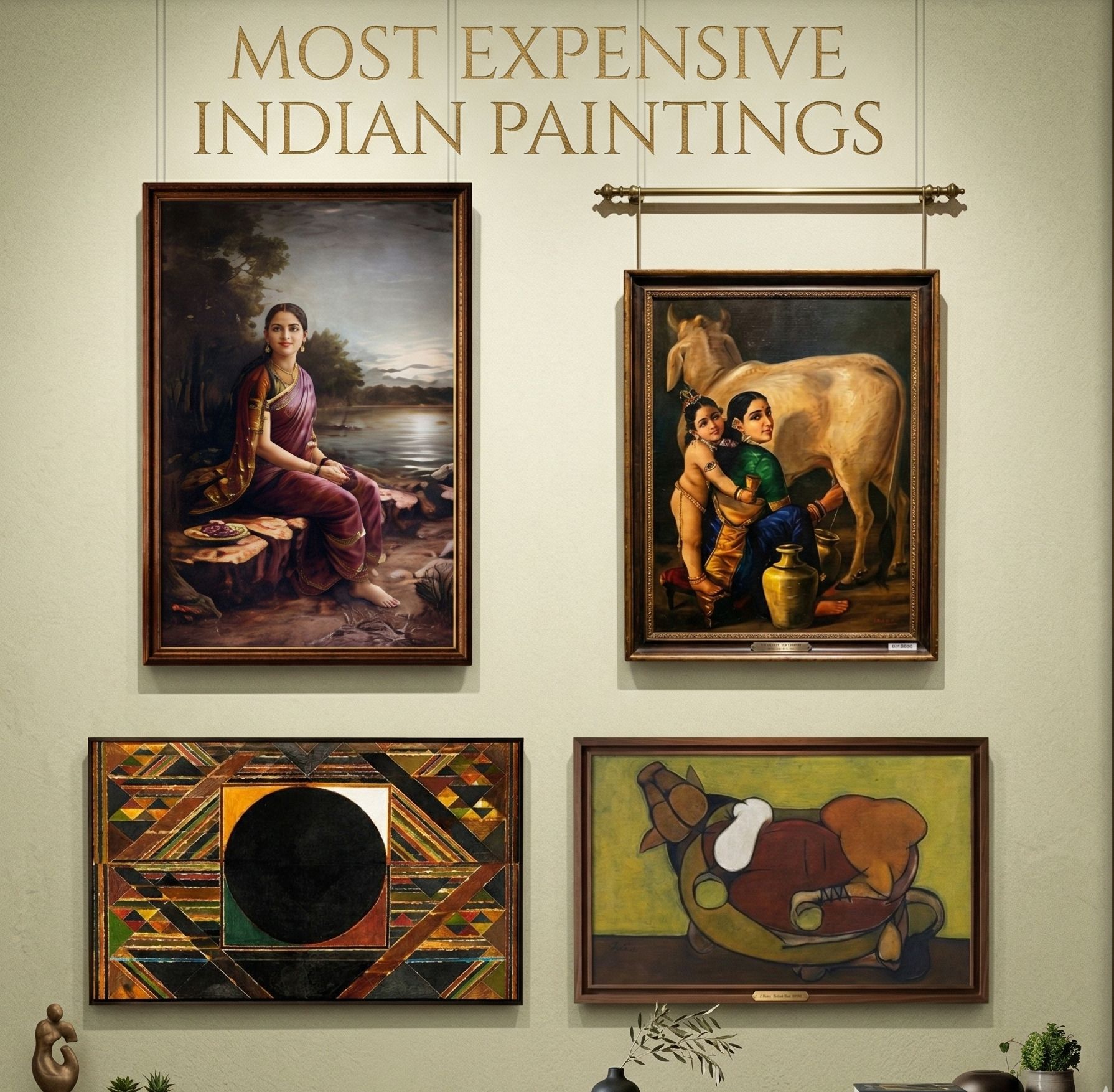
Top 10 Most Expensive Indian Paintings Ever Sold
Paintings are invaluable. They carry imagination, labour, and passion within every brushstroke. A canvas is never just a surface—it is a space where personal expression, culture, and history come alive.
Did you know that the most expensive painting in the world is Salvator Mundi by Leonardo da Vinci? It sold for a staggering $450.3 million in November 2017 in New York to a Saudi prince.
However, Indian art and artists are in no way behind their European counterparts. Over the years, they have earned immense recognition at global auction houses.
India’s modern and contemporary art market has been on a remarkable growth trajectory, both culturally and financially. In recent years, iconic works by India’s master painters have fetched astronomical sums at auctions.
If you thought million-dollar price tags were reserved only for European masters, it’s time to rethink. The past decade has seen several Indian masterpieces cross that threshold with ease.
In this blog, we present some of the most expensive Indian paintings ever sold. These names represent the very best of Indian art history.
Also Read: The Rise of Expressionism in Indian Modern Art
Top Most Expensive Paintings Sold by Indian Artists
-
Raja Ravi Varma – Yashoda and Krishna
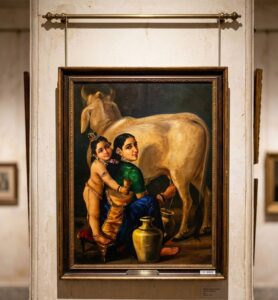
Price: ₹167.2 crore ($17.9 million)
Raja Ravi Varma’s 1890s masterpiece Yashoda and Krishna made history when it sold for ₹167.2 crore on April 1, 2026, becoming the most expensive Indian artwork ever sold. The painting was acquired by Cyrus Poonawalla of the Serum Institute of India.
This sale marks a defining moment for Indian art. It reflects the immense demand for high-provenance works and highlights Varma’s legacy. He is often regarded as the crown jewel of Indian art, known for blending European realism with Indian mythological themes.
-
M. F. Husain – Untitled (Gram Yatra) (1954)
Price: ₹118 crore ($13.8 million)
Untitled (Gram Yatra) shattered records when it sold for ₹118 crore in March 2025. This sweeping canvas captures the vibrancy and rhythm of rural India.
M.F. Husain, often referred to as the “Picasso of India,” remains one of the most influential figures in Indian modern art. His bold lines, dynamic compositions, and storytelling ability continue to resonate with collectors worldwide.
-
V. S. Gaitonde – Untitled (1970)

Price: ₹67 crore ($7.57 million)
A pioneer of abstract art in India, V.S. Gaitonde’s untitled 1970 painting fetched ₹67.08 crore at auction in 2025.
The artwork features translucent layers of ochre and subtle floating forms, reflecting his meditative approach to painting. Gaitonde’s work is known for its quiet intensity, where structure and control exist beneath an apparently free-flowing surface.
-
Amrita Sher-Gil – The Storyteller
Price: ₹61.8 crore ($7.4 million)
The Storyteller is a vibrant oil-on-canvas painting depicting women engaged in everyday rural life. It is one of Sher-Gil’s most evocative works.
This painting showcases her unique ability to merge European techniques with Indian themes. Sher-Gil is widely regarded as one of the most important artists of 20th-century India, and her works continue to command global attention.
-
Tyeb Mehta – Trussed Bull
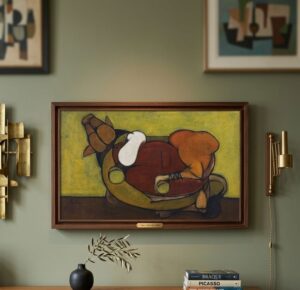
Price: ₹61.80 crore
Inspired by an Egyptian bas-relief he encountered at the British Museum in 1954, Trussed Bull is one of Tyeb Mehta’s most iconic works.
The painting conveys tension, struggle, and restrained energy. Mehta’s minimalist yet powerful style helped redefine modern Indian art.
-
S. H. Raza – Gestation
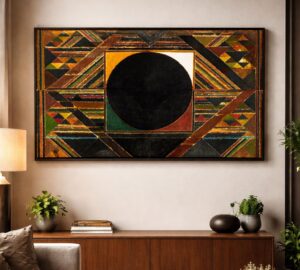
Price: ₹51.75 crore
Painted in 1989, Gestation represents the peak of Raza’s metaphysical phase. The artwork prominently features his signature “Bindu,” symbolizing the cosmic source of creation.
This large acrylic painting reflects Raza’s deep connection to Indian philosophy and spirituality. It remains one of the most celebrated works in Indian contemporary art.
-
Tyeb Mehta – Bull on Rickshaw
Price: ₹41.97 crore ($5.6 million)
Bull on Rickshaw (1999) combines several recurring motifs in Mehta’s work—the bull, the falling figure, and the rickshaw.
The painting presents a powerful image of vulnerability and suffering. The bull appears tense and restrained, symbolizing the human condition and societal pressures.
-
F. N. Souza – Birth (1955)
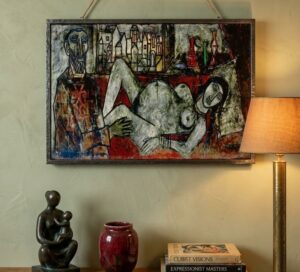
Price: ₹26.9 crore
Birth is one of Souza’s most controversial and important works. It portrays the intense pain and emotion associated with childbirth.
Souza is known for exploring darker themes in society. His works often challenge norms and provoke thought, making him a key figure in Indian modernism.
-
Raja Ravi Varma – Radha in the Moonlight

Price: ₹23 crore ($3.4 million)
This painting, sold at an auction in Mumbai in 2016, depicts Radha in a moment of longing under a serene moonlit sky.
It beautifully showcases Varma’s mastery in combining Indian mythology with European academic realism. The emotional depth of the piece continues to captivate viewers.
-
Amrita Sher-Gil – Self-Portrait
Price: ₹19.4 crore ($2.92 million)
A rare self-portrait by Amrita Sher-Gil, created in the early 1930s, fetched nearly ₹19 crore at an auction.
Most of her works are housed in the National Gallery of Modern Art in New Delhi, making pieces in private collections extremely rare. This adds significantly to their value and demand.
What Makes Indian Paintings So Expensive?
Several factors contribute to the high value of Indian paintings:
-
Rarity
Many masterpieces are held in museums or private collections, making them difficult to acquire.
-
Historical Significance
Artists like those from the Progressive Artists’ Group revolutionized Indian art after independence.
-
Artistic Innovation
From realism to abstraction, Indian artists have consistently pushed boundaries.
-
Cultural Depth
Indian paintings often carry deep narratives rooted in mythology, tradition, and social realities.
It is woven with stories, emotions, and a deep connection to the country’s diverse culture and heritage.
Impact on the Indian Art Market
These high-value sales have done more than set records. They have reshaped the perception of Indian art globally.
Indian modernists are now commanding prices comparable to Western artists. Auction houses are paying closer attention to Indian works, and collectors are actively investing in them.
This momentum has also strengthened the domestic art market.
Emerging Trends in Indian Art Collecting
The surge in record-breaking sales has also revealed clear shifts in how Indian art is being collected and appreciated today.
-
Rise of New-Age Collectors
A younger generation of collectors is entering the market. These buyers are not just investing for prestige but also for passion.
-
Growing Global Demand
Indian art is no longer confined to domestic collectors. International buyers and institutions are actively participating in auctions, driving up competition and prices.
-
Digital Influence and Online Auctions
The shift toward online platforms has made art more accessible. Digital auctions are expanding their reach, allowing collectors from across the world to participate easily.
Final Thoughts
The rise in prices of Indian paintings is not just about money. It reflects recognition, respect, and global appreciation for Indian creativity.
From Raja Ravi Varma’s mythological elegance to M. F. Husain’s bold narratives, each artist has contributed to shaping India’s artistic identity.
These record-breaking sales are milestones. They remind us that Indian art is not just culturally rich but also globally valued.
And as the market continues to grow, one thing is certain—the world is finally paying the attention Indian art has always deserved.
Giftex: Modern and Contemporary Art Auction
This April, Giftex is back with a bang with its art auction.
Get ready as we present art lovers and collectors with a carefully curated collection of exceptional modern and contemporary Indian art.
From iconic masters to remarkable works, this auction brings together pieces that truly stand out.
Don’t miss the chance to explore and acquire something extraordinary.


About Post Author