Sèvres Porcelain: From Royal Obsession to Global Luxury
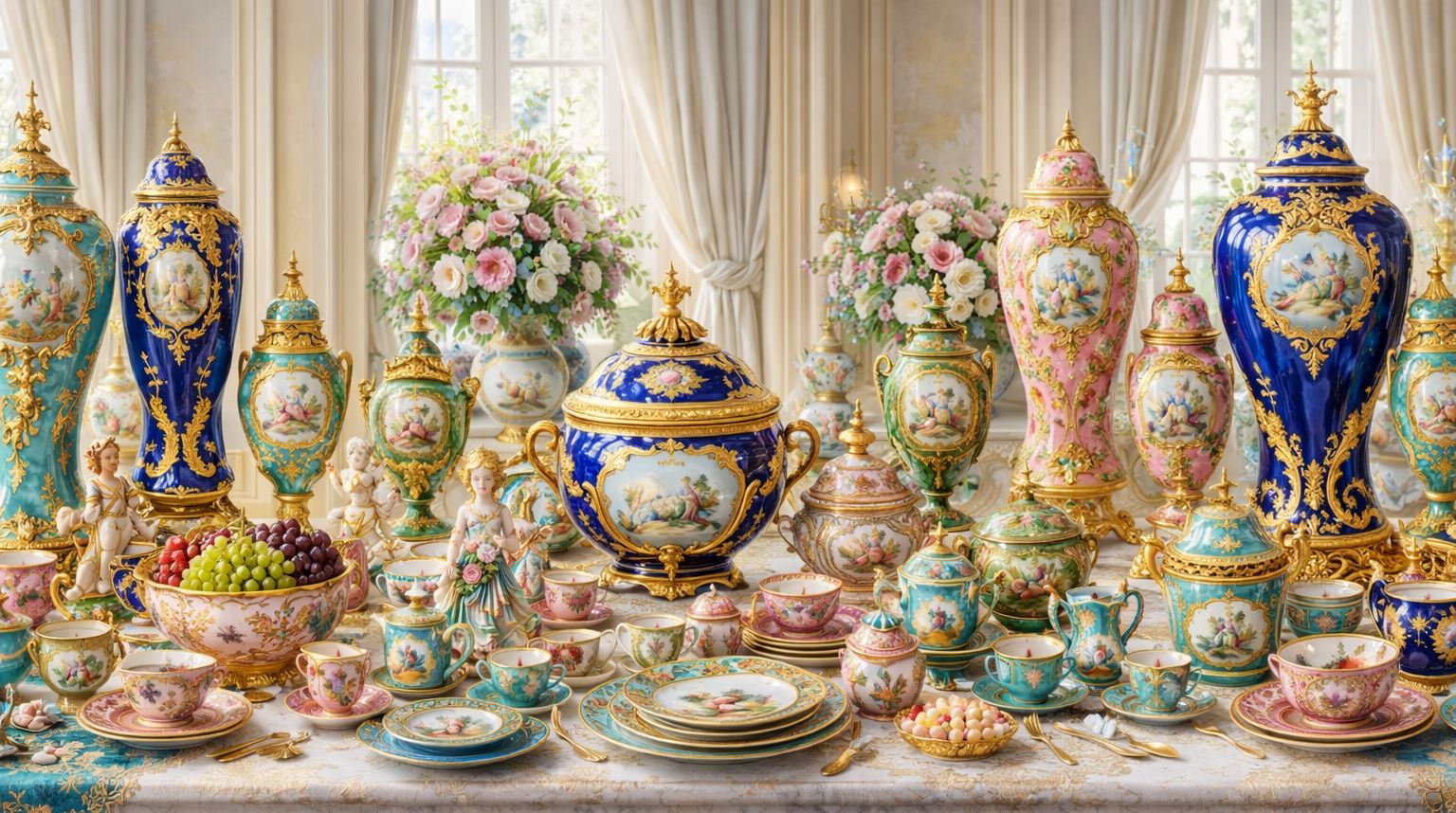
In the 18th century, porcelain was one of the most prized commodities in the world. Often described as “white gold,” it was a luxury reserved almost exclusively for royalty and the wealthiest members of society. Delicate yet durable, luminous yet strong, Chinese porcelain objects fascinated European collectors who admired the beauty of pieces imported from Asia.
The mystery surrounding porcelain only increased its value. For nearly two thousand years after its invention in China, the exact formula used to create true hard-paste porcelain remained a closely guarded secret known only to Chinese and Japanese artisans.
That changed in the early 18th century when the first true porcelain outside Asia was successfully produced in Germany.
Yet it was in France, in an unassuming town just outside Paris, that porcelain making would reach new artistic heights. The factory known as the Manufacture Nationale de Sèvres, more commonly referred to simply as Sèvres, would grow into one of the most prestigious porcelain manufacturers in the world.
This is the story of how a ceramics factory founded to imitate foreign porcelain ultimately became one of the greatest centers of decorative arts in Europe.
Also Read: A Beginner’s Guide to Collecting Porcelain
The Beginning: Europe’s Obsession with “White Gold”
By the early 1700s, porcelain had become a symbol of prestige across European courts. Royal collections displayed elaborate vases, dinner services, and figurines imported from China and Japan. The breakthrough for Europe came in 1708, when craftsmen at the Meissen porcelain factory in Germany finally discovered the formula for hard-paste porcelain similar to Chinese wares. Meissen quickly became influential across the continent, and European rulers were eager to establish their own porcelain industries.
Among them was King Louis XV of France, who was determined that France should rival Germany’s success. To achieve this, he tasked French artisans with discovering the secret of porcelain production and building a national manufactory capable of competing with Meissen.
The Vincennes Factory and the Birth of Sèvres
France’s early porcelain experiments began at a factory established in the Parisian suburb of Vincennes in the 1740s. The factory was placed under the artistic leadership of the talented French ceramicist Jean-Claude Duplessis.
One of the most influential supporters of the factory soon emerged: Madame de Pompadour, the powerful patron of the arts and mistress of Louis XV. Under her patronage, the factory began to flourish.
In 1756, Madame de Pompadour requested that the factory be moved to the town of Sèvres, closer to her château. The relocation transformed the manufactory’s identity. From that point forward, it became known simply as Sèvres.
From Imitation to Innovation
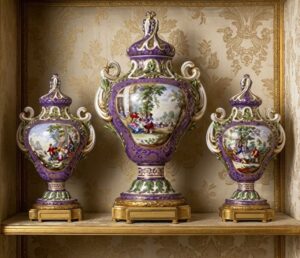
In its earliest years, Sèvres porcelain was created largely in imitation of Meissen and Asian porcelain. Like many European manufacturers of the time, the French artisans were still attempting to reproduce the secret of hard-paste porcelain.
The breakthrough finally came in 1770 when French scientists and artisans succeeded in discovering the formula for hard-paste porcelain. With this discovery, Sèvres became only the second manufacturer in Europe to master the technique.
No longer an imitator, Sèvres had become a leader in porcelain production.
The Iconic Colours of Sèvres
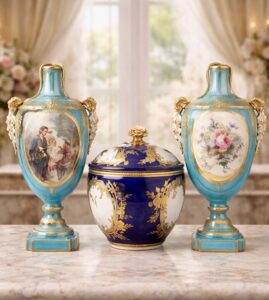
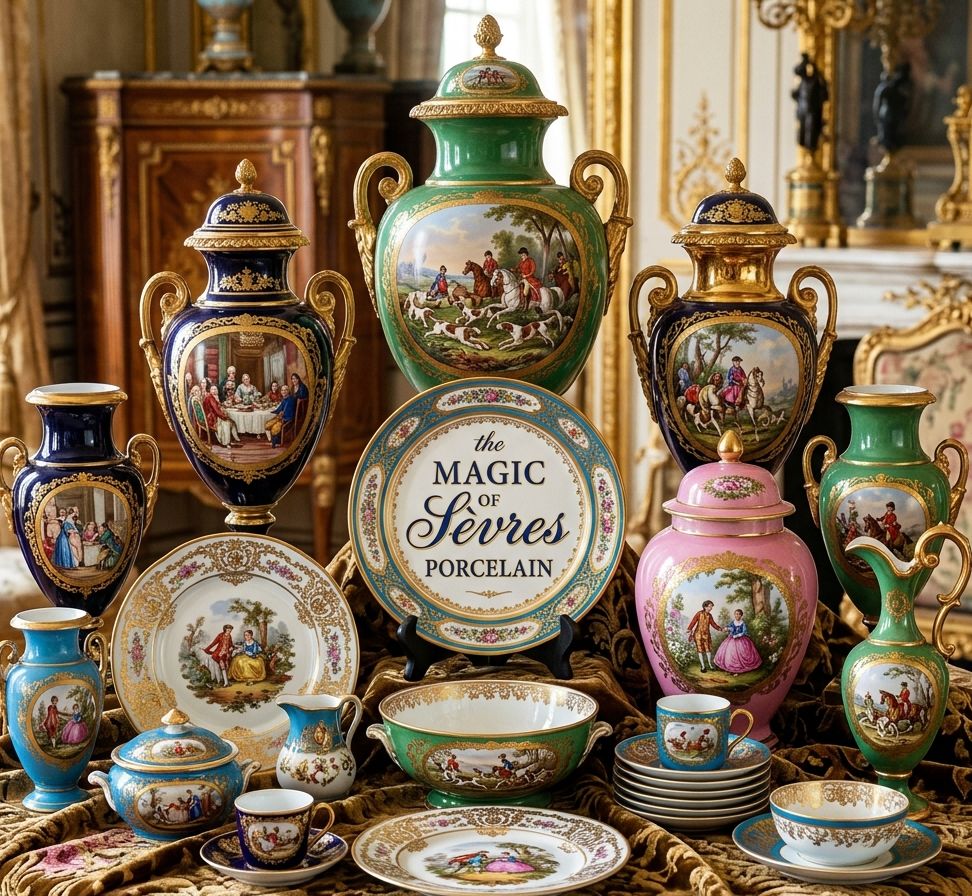
One of the most recognizable characteristics of Sèvres porcelain is its extraordinary use of colour. Perhaps the most famous is bleu Sèvres, a deep, rich blue created by adding cobalt oxide to the glaze. This distinctive shade became closely associated with the factory and appeared on many of its most celebrated pieces.
Another notable colour was bleu céleste, or “heavenly blue,” a lighter sky-blue shade used for a dinner service commissioned for King Louis XV in the 1750s.
Beyond blue, Sèvres porcelain featured an impressive range of colours. Soft pinks, vibrant greens, pure whites, and lavish gold decoration all appeared in the factory’s designs.
What Does Sèvres Porcelain Look Like?
Sèvres porcelain is known for its vibrant colour combinations, intricate painting, and elegant shapes.
In many of the pieces, artists painted:
- Courtly life and aristocratic gatherings
- Landscapes and pastoral views
- Classical mythology
- Birds and animals
- Military or maritime subject
- Hunting scenes
These painted panels were often surrounded by elaborate gilding, which added to the luxurious appearance of the pieces.
How to Identify Genuine Sèvres Porcelain
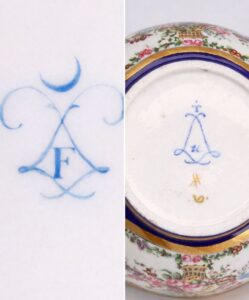
Authentic Sèvres porcelain typically carries a distinctive mark on the underside of the piece.
The most recognizable mark consists of two interlaced letter “L”s. Inside the double-L mark is usually a small letter indicating the year in which the piece was produced.
Additional marks may identify the painter, decorator, or gilder who worked on the object.
Famous Sèvres Creations
Because Sèvres served as the porcelain factory of the French state, it frequently produced elaborate works for royal households and diplomatic gifts.
- Royal Dinner Services
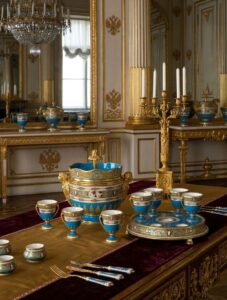
Large porcelain services were often given as diplomatic gifts between royal courts, reinforcing alliances and displaying national craftsmanship.
One remarkable example was a monumental dinner service of roughly 700 pieces commissioned in the 1770s by Catherine the Great of Russia.
- Porcelain Vases
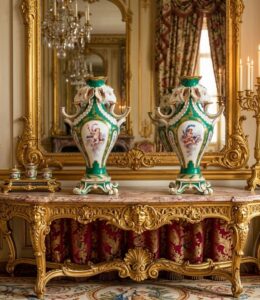
Sèvres vases became some of the most iconic decorative objects produced by the factory.
Among the most famous were the “elephant head” vases, whose handles were sculpted in the form of elephant heads.
In the early 19th century, the manufactory produced the celebrated Clodion vases, inspired by classical sculpture.
- Biscuit Figures

Another popular category was biscuit porcelain figures. These unglazed white sculptures have a matte surface that resembles marble.
Often depicting mythological figures, nymphs, putti, or scenes from classical antiquity, biscuit figures became fashionable decorative pieces.
What Is “Sèvres Style”?
The prestige of Sèvres porcelain led many other European factories to imitate its designs. By the early 19th century, manufacturers across the continent were producing porcelain inspired by Sèvres’ colours, shapes, and decorative techniques.
Some even copied the factory’s famous double-L mark associated with Louis XV.
Because of this widespread imitation, not every porcelain piece marked with the double-L symbol was actually produced at the Sèvres factory. Today, these pieces are often described as “Sèvres style” porcelain rather than authentic Sèvres works.
Collecting Sèvres Porcelain
Today, Sèvres porcelain remains highly collectible. Important pieces frequently appear at major auction houses and can command extremely high prices.
Collectors often look for:
- Strong, vivid colours such as Sèvres blue
- Detailed hand-painted cartouches
- Complex gilding
- Unique forms like elephant-head vases
- Clear and well-preserved factory marks
- Condition is also critical. Chips, cracks, or restoration can significantly affect value.
- For serious collectors, provenance and documentation can add further importance to a piece.
Sèvres Today
Remarkably, the Manufacture Nationale de Sèvres remains operational today. The factory continues to produce porcelain dinner services, vases, plaques, and sculptures, utilising many of the same techniques developed during the 18th and 19th centuries.
A museum now stands on the factory site, preserving the long history of Sèvres and displaying some of its most extraordinary works.
Conclusion
What began as an attempt to imitate foreign porcelain ultimately became one of the greatest achievements in European decorative arts. From its early days at Vincennes to its rise under royal patronage, the Sèvres manufactory transformed porcelain into a symbol of French creativity and craftsmanship.
Through innovative colours, refined painting, and technical experimentation, Sèvres established a style that influenced ceramic production across Europe.
More than two centuries later, the legacy of Sèvres porcelain endures. Its luminous blues, intricate designs, and elegant forms remain timeless reminders of an era when porcelain truly was the “white gold” of Europe.
Giftex: A World of Collectibles Auction
This March, Giftex is back with its famous A World of Collectibles Auction.
From fine porcelain and vintage furniture to elegant silver and beautiful textile treasures, this auction brings together pieces from different eras and styles. Whether you’re a seasoned collector or just starting, there’s something here for everyone.


About Post Author