
Whispers in Clay: The Timeless Allure of Antique Ceramics
Imagine you’re walking through a quiet antique shop. The shelves are lined with delicate teacups, hand-painted plates, and porcelain figurines frozen in time. You pick one up. It feels smooth, slightly cool in your hand. You turn it over and notice a faded stamp on the base. Suddenly, it’s not just a dish. It’s a story. Who used it? What table did it sit on? What conversations happened around it?
That’s the quiet magic of antique and vintage ceramics. They are more than decorative objects. They carry history, craftsmanship, and a sense of connection to the past. Antique ceramics, pottery, and porcelain are often among the most affordable collector’s items on the market. Vintage and antique pottery and ceramics are highly sought after. Unlike paintings or tapestries, you don’t need a wall to hang them on. Ceramics can be part of your everyday life.
In this post, we’ll explore the types of ceramics, their history, why they’re collectible, what makes them valuable, and how to care for them properly.
Also Read: Types of Antique Porcelain
History of Ceramics
Ceramics is one of the oldest art forms, dating back thousands of years.
-
Ancient Beginnings
The oldest known ceramic artefact is dated as early as 28,000 BCE, during the late Palaeolithic period. It is a statuette of a woman, named the Venus of Dolní Věstonice, from a small prehistoric settlement near Brno, in the Czech Republic.
-
Classical & Medieval (600 BCE – 1400s AD)
Greek black-and-red figured pottery (600–400 BC) and Roman Arretine ware set high standards.
-
Chinese Dominance
In ancient China, porcelain was perfected during the Tang and Song dynasties. This fine, translucent material later became highly prized in Europe.
-
European Porcelain & Refinement (1700s–1800s)
By the 18th century, European factories such as Meissen Porcelain Manufactory in Germany and Royal Worcester in England were producing high-quality porcelain that rivalled Chinese imports.
-
20th Century (Vintage Era)
This period included highly sought-after styles like Art Nouveau, Art Deco, Mid-Century Modern (MCM), and Studio Potter.
What Are Ceramics?

Antique ceramics encompass diverse, historic fired-clay objects, created by shaping and then firing a non-metal material, such as clay, at a high temperature.
Ceramics are permanently changed when they are placed under this intense heat during the firing process. Traditional ceramics are made using clay, with additional ingredients added to create different types of ceramics.
Types of Ceramics
When collecting or learning about ceramics, it helps to understand the main types.
Most types of antique and vintage ceramics are classified according to three primary attributes:
- Paste: the characteristics of the clay from which the vessel is made
- Surface Treatment: the way the surface of the vessel is treated, covered or glazed
- Decoration: the methods, colours, and motifs used to decorate the vessel
Based on this classification, the major types of ceramics can be classified as:
-
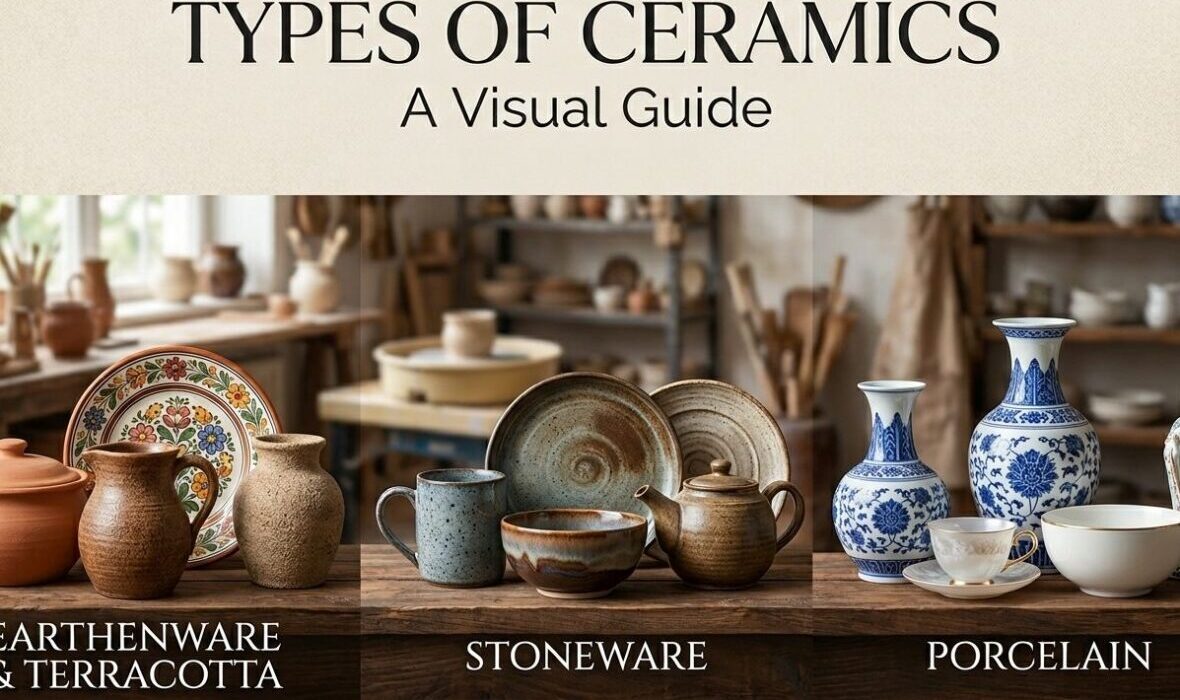
Earthenware (also known as “earthenware”, “terra cotta”, or “pottery”)

Earthenware is one of the oldest and most common ceramic types. It is fired at a lower temperature (900-1200° C), making it slightly porous unless glazed.
Examples include traditional country pottery, redware, and some decorative plates. It often has a warm, rustic look. Because it’s more fragile and porous, it’s generally less durable than other types.
-
Stoneware

Stoneware is fired at a higher temperature (1200-1350° C) than earthenware, making it stronger and less porous. It’s heavier and more durable.
Many antique crocks, jugs, and storage containers are made of stoneware. In the United States, 19th-century salt-glazed stoneware from regional potteries is particularly collectible.
-
Porcelain

Porcelain is the most refined type of ceramic. It is fired at very high temperatures (1300-1450° C), resulting in a hard, white, often translucent material.
Fine china, figurines, and decorative vases are often porcelain. Porcelain is usually the most valuable of the three types.
Surface Glazes: The Finishing Touch That Defines a Piece
After the ceramic body is formed and fired, the glaze is applied. This protects the piece and adds colour, shine, texture, and depth. In many cases, the glaze is just as important as the clay body itself. What is a ceramic glaze?
A glaze is made from a mixture of silica, minerals, and metal oxides added during the firing process to create smooth, shiny surfaces.
-
Clear Glaze

Clear glaze is transparent and allows the natural colour of the clay or painted decoration underneath to show through. It is commonly used on porcelain and decorated earthenware.
-
Crackle Glaze

Crackle glaze, also called crazing, features a network of fine cracks on the surface. In some cases, this happens naturally with age. In others, it is intentionally created as a decorative effect.
-
Matte Glaze

Matte glazes have a soft, dull finish rather than a shiny surface. They became especially popular in art pottery during the late 19th and early 20th centuries.
-
Celadon Glaze

Celadon is a translucent glaze, often in soft green or blue-green shades. It has a smooth, jade-like appearance.
-
Salt Glaze
Salt glaze is created by throwing salt into the kiln during firing. The salt reacts with the clay surface, producing a slightly textured, glossy finish that often resembles the skin of an orange.
-
Luster Glaze
Luster glaze produces a metallic sheen, often in gold, copper, or iridescent tones. It became popular in different periods, including the late 19th century.
-
Opaque Glaze
Unlike clear glaze, which allows the surface underneath to show through, opaque glaze contains materials such as tin or zinc that create a solid, non-transparent finish.
How Do You Know If Ceramics Are Valuable?
Value depends on a mix of history, condition, craftsmanship, and market demand.
Here’s what to look for.
-
Authenticity
Authenticity is the starting point. A genuine piece from a known maker will almost always be worth more than a reproduction.
Turn the item over and check the base. Look for a maker’s mark, stamp, signature, or symbol. Many established manufacturers marked their work clearly.
-
Condition
Condition plays a huge role in value.
Carefully inspect the ceramic under good lighting. Look for:
- Chips along the rim or base
- Hairline cracks
- Crazing in the glaze
- Repairs or glue marks
- Scratches in painted or gilded areas
Even small damage can reduce the value significantly, especially in fine porcelain.
-
Rarity
Rarity is another key factor.
If a ceramic pattern or model was mass-produced and widely distributed, it is likely to be less valuable today. Ask yourself:
- Was this made for a brief period?
- Was it discontinued quickly?
- Is it hard to find complete sets?
-
The Value of the Glaze
Glaze quality can significantly affect value.
Certain glaze types are more technically demanding and historically important.
-
Provenance
Provenance means a documented history of ownership.
If a ceramic piece can be traced to a notable collection, historical figure, or important exhibition, it may carry additional value.
How To Clean Antique & Vintage Ceramics
Before you clean your ceramic, you need to make sure you know the type of ceramic you’re handling, as well as any other materials that might be on the object.
-
Avoid the Dishwasher
Never put antique or valuable vintage ceramics in the dishwasher. The heat and harsh detergents can damage the glaze and decoration.
-
Use Gentle Cleaning Methods
Wash by hand using lukewarm water and mild dish soap. Use a soft sponge or cloth. Avoid abrasive scrubbers.
-
Be Careful with Gilding and Hand-Painting
Gold trim and delicate painted designs can wear off easily. Clean these areas very gently and avoid prolonged soaking.
-
Removing Stains
For interior stains, such as tea marks in cups, a paste of baking soda and water can sometimes help. Rub very lightly and rinse thoroughly.
-
Dry Properly
Air dry on a soft towel or gently pat dry with a lint-free cloth. Avoid stacking pieces while they are still damp.
Final Thoughts
Antique and vintage ceramics connect us to everyday life from another time. A simple bowl or teacup can carry decades, even centuries, of history. These objects were once part of someone’s daily routine. Today, they can become part of yours.
Whether you’re drawn to rustic stoneware, elegant porcelain, or colourful mid-century pottery, collecting ceramics is about more than value. It’s about appreciation. It’s about preserving craftsmanship and stories.
Giftex: A World of Collectibles Auction
This March, Giftex is set to unveil its latest edition of A World of Collectibles auction, and it’s shaping up to be one of its most exciting events yet.
From antique and vintage collectibles to rare books, textiles, and decorative objects, the auction promises something for every kind of collector. Whether you’re an experienced bidder with a focused collection or someone just beginning to explore the world of antiques, this event offers a wide range of opportunities.