Symmetry Meets Spirit: Hidden Geometry Behind Modern Indian Art
Deep within the heart of Indian spirituality lies an art form that has captivated minds and souls for millennia: symmetry and geometry. In Indian art, geometry was never used by accident. Instead, it was treated as a deliberate system of order, measurement, and belief. Circles, triangles, grids, and lattices were not simply added for decoration. They were used to structure space intellectually as well as spiritually.
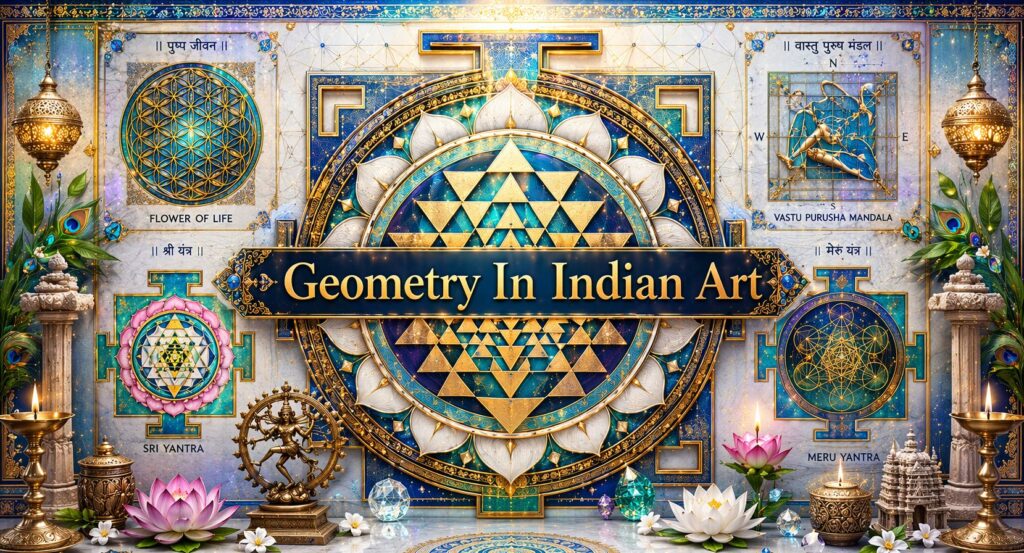
Sacred geometry, therefore, can be understood as the use of specific shapes and proportions that are believed to reflect the cosmic order. Motifs such as mandalas and yantras have been described in ancient texts like the Vedas and Upanishads, and their relevance has continued into modern artistic expression.
Have you ever noticed the spiral of a flower or the curve of a seashell and felt a strange sense of familiarity? That feeling is often explained as an intuitive connection to sacred geometry. These universal patterns are not only seen in nature but are also believed to exist within human consciousness.
In this comprehensive guide, the role of sacred geometry and symmetry in modern Indian art and design will be explored. Whether you are an artist seeking inspiration, an art lover trying to deepen your understanding, or a spiritual seeker exploring cosmic connections, this journey will offer clarity and insight.
Also Read: Top 10 Contemporary Indian Artists
Why Geometry is Considered Sacred
Sacred geometry is often described as a bridge between the physical and the spiritual. The patterns are believed to represent the blueprint of creation itself.
Firstly, these forms are found repeatedly in nature. From the arrangement of petals to the formation of galaxies, geometry appears to govern natural design.
Secondly, geometric patterns are often used in meditation. When viewed or drawn, they can help focus the mind and create a sense of calm.
Lastly, sacred geometry carries symbolic meaning. Each shape is associated with specific energies or concepts, allowing it to communicate ideas beyond words.
Sacred Geometry in Modern Indian Art
In India, geometry in modern art has been reinterpreted rather than abandoned. Ancient Vedic and Tantric patterns such as mandalas, yantras, and the bindu have been transformed into abstract visual forms.
The Mandala: A Circle of Meaning
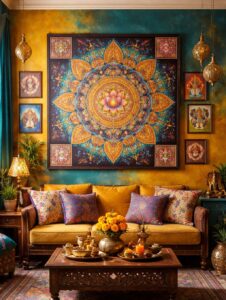
The mandala is one of the most recognised symbols of sacred geometry. Derived from the Sanskrit word for “circle,” it represents wholeness, balance, and cosmic harmony.
What a Mandala Symbolises
A mandala is often seen as a map of the universe. At its center lies a focal point, from which patterns radiate outward. This structure reflects the idea of creation emerging from a single source.
Key meanings associated with mandalas include:
- Unity and completeness
- The cycle of life and existence
- Balance between inner and outer worlds
- Spiritual awakening
Mandalas in Indian Art
Over time, mandalas have been adapted into various Indian art forms. From paintings to rangoli designs, they have been reimagined with unique styles and motifs.
Yantra: The Geometry of Energy
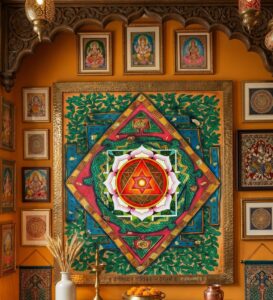
While mandalas are often expressive, yantras are more structured and symbolic. The word “yantra” refers to a tool or instrument, and in a spiritual sense, it is considered a device for harnessing energy.
At the center of a yantra lies the bindu, a single point that represents the origin of all creation. This point is seen as the meeting place of dual forces.
Elements of a Yantra
A typical yantra is composed of several geometric components:
Bindu (dot): Represents unity and cosmic origin
Triangles (trikona):
- Upward triangles symbolise masculine energy
- Downward triangles represent feminine energy
Square (bhupura): Acts as a boundary, often with four gates
These elements are arranged with mathematical precision.
Yantra in Indian Art
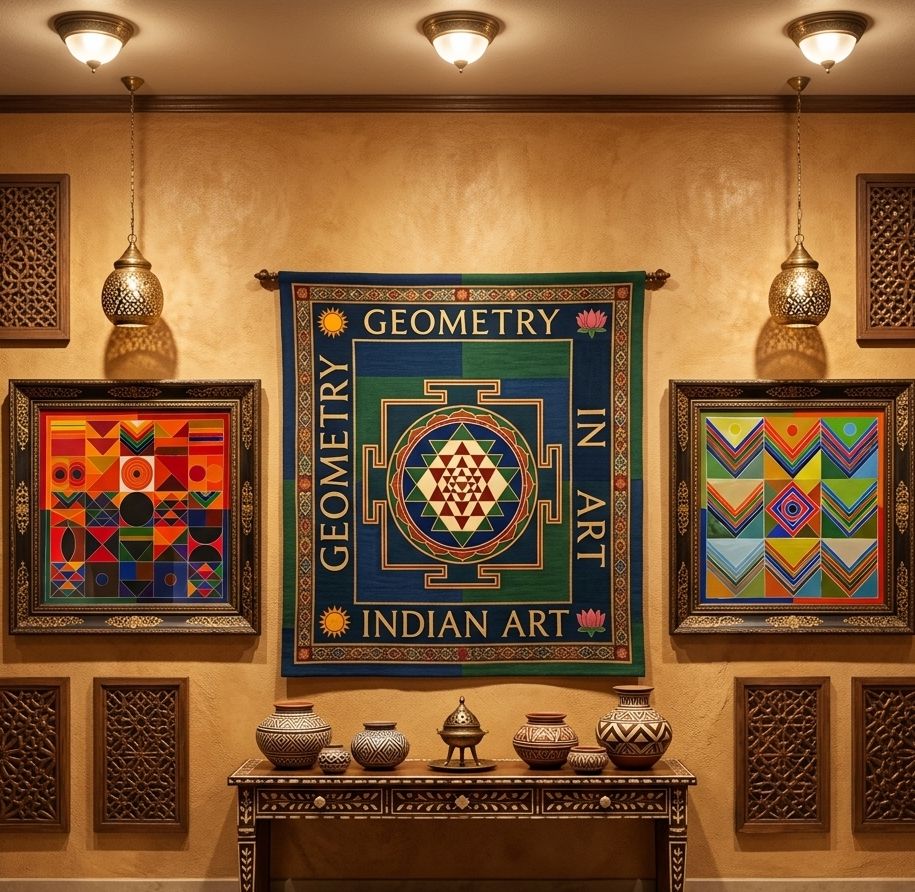
In both traditional and modern contexts, yantras have been used as meditative diagrams. Contemporary artists often reinterpret these forms using bold colours and abstract compositions.
Key Aspects of Sacred Geometry in Modern Indian Art
Sacred geometry in modern Indian art has not been replicated in its original form. Instead, it has been reinterpreted through abstraction, symbolism, and contemporary techniques.
- S.H. Raza and the Bindu
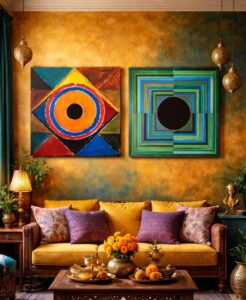
One of the most significant contributions to sacred geometry in modern Indian art has been made by S.H. Raza. His work has been centered around the Bindu, a simple yet profound geometric point.
The Bindu is not treated as just a dot. It is understood as the origin of creation, the cosmic seed from which all forms emerge.
2. Tantra Painting Revival
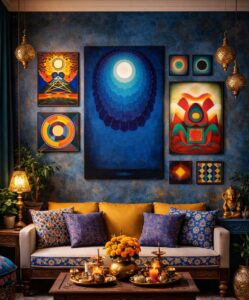
In modern Indian art, a revival of Tantra painting has been observed, particularly from the mid-20th century onward.
Artists have explored these mystical diagrams using:
- Bold and saturated colours
- Precise, calculated lines
- Layered geometric compositions
- Abstraction of Mandalas
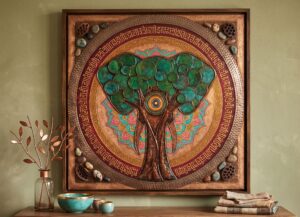
The mandala has also been abstracted in modern Indian art. Rather than being depicted in its traditional, highly detailed form, it has been simplified and restructured.
Even so, its core function has been retained.
- Mathematical Precision
Despite the shift toward abstraction, mathematical precision has not been abandoned. Geometric shapes such as circles, squares and triangles are still used deliberately.
- Symbolic Abstraction
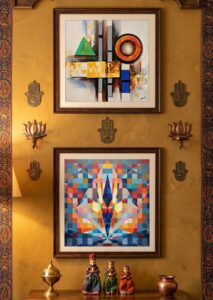
Another key aspect is symbolic abstraction. Artists do not always depict sacred geometry in literal forms. Instead, its essence is conveyed through simplified shapes and spatial relationships.
Key Artists in Sacred Geometry and Modern Indian Art
The exploration of sacred geometry in modern Indian art has been shaped by several influential artists.
- S.H. Raza
S.H. Raza remains one of the most recognised figures in this space. His Bindu series has been widely celebrated for its ability to translate spiritual philosophy into visual form.
- Akkitham Narayanan
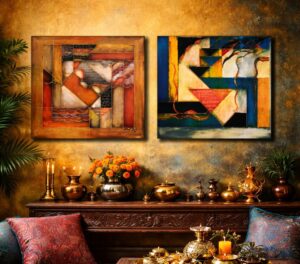
Akkitham Narayanan’s work is known for its intense and layered compositions. Geometry is used as a means to explore inner consciousness and cosmic order.
- Biren De
Biren De has been a key figure in the Neo-Tantric movement. His work frequently includes mandalas, crescents, and radiating forms.
- Sohan Qadri
Sohan Qadri approached art as a meditative practice. His work combines geometric abstraction with textured surfaces and subtle colour variations.
- Om Prakash Sharma
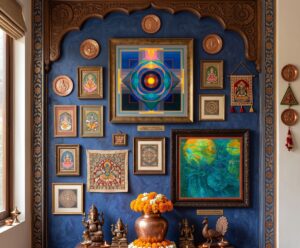
Om Prakash Sharma has contributed to the Neo-Tantric movement through abstract compositions rooted in geometry.
- Tyeb Mehta
Although not strictly a geometric artist, Tyeb Mehta has used sharp lines and divided spaces to create powerful compositions.
His work demonstrates how geometric abstraction can be used to convey tension, fragmentation, and existential themes.
Common Themes
Despite their individual styles, several shared themes can be identified:
- Neo-Tantrism: A movement that reinterprets traditional yantras and mandalas in abstract forms
- Cosmic symbolism: Exploration of universal energy, creation, and consciousness
- Spiritual abstraction: Art used as a medium for meditation and introspection
- Balance and duality: Representation of opposing forces and their harmony
Benefits of Sacred Geometry in Art and Design
The use of sacred geometry is not limited to aesthetics. It offers several deeper benefits.
- Mental Clarity and Focus
Geometric patterns and symmetry help calm the mind and improve concentration.
- Emotional Balance
Balanced designs can create a sense of harmony.
- Spiritual Connection
Sacred geometry is believed to connect individuals with universal energy.
- Timeless Aesthetic Appeal
Because these patterns are rooted in natural laws, they remain visually appealing across generations.
Final Thoughts
Sacred geometry and symmetry have played a foundational role in Indian art and design for centuries. While their origins lie in ancient spiritual traditions, their relevance has not diminished.
Instead, these geometric principles have been reinterpreted in modern contexts. Through art, architecture, and design, they continue to bridge the gap between the past and the present.
Ultimately, sacred geometry is more than a visual language. It is a way of understanding the world, one that connects structure with meaning and form with consciousness.
Giftex: Modern and Contemporary Indian Art Auction
This April, Giftex brings back its renowned Modern Indian Art Auction. Discover masterpieces and rare treasures, and bring home a piece of India’s rich artistic legacy.


About Post Author