Eco-Friendly Art in India: From Tradition to Modern Practice
In recent years, sustainability has gained significant traction across various sectors. As people become more conscious of their environmental impact, the demand for eco-friendly products has risen dramatically. The art world, too, has started responding to this shift. Increasingly, artists are rethinking how materials are sourced, used, and discarded.
Interestingly, Indian traditional art forms have always been rooted in sustainable practices. Long before sustainability became a global movement, Indian artisans were creating art using natural, locally available resources. Therefore, these traditions offer valuable insights for modern eco-friendly art practices.
In this blog, the relationship between art and sustainability is explored. At the same time, both traditional and contemporary approaches are examined to understand how Indian artists are bringing eco-friendly practices into contemporary and modern Indian art.
Also Read: Indian Minimalism in Contemporary Art
Understanding Sustainable Art
To begin with, sustainability refers to the ability to maintain ecological balance while meeting present needs without compromising future generations.
In the context of art, sustainability is not limited to materials alone. It also includes the methods of production, energy usage, and waste management.
Sustainable art can be defined as the practice of creating artwork using eco-friendly and indigenous materials such as natural dyes, bamboo, clay, and recycled elements. As a result, their environmental impact is significantly lower compared to synthetic alternatives.
Indigenous Materials: The Foundation of Indian Art
Indian art has always been deeply connected to nature. Traditionally, artists relied on materials that were easily available in their surroundings. Because of this, the use of indigenous materials became a defining feature of Indian art.
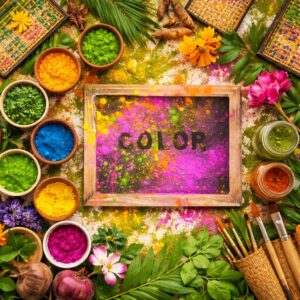
For example, natural dyes were extracted from plants, flowers, and minerals. Similarly, bamboo, leaves, mud, and rice flour were commonly used in artistic practices. These materials were not only sustainable but also culturally meaningful.
Traditional Indian Art Forms
Indian traditional art forms have long demonstrated how creativity can exist in harmony with nature.
- Madhubani Art
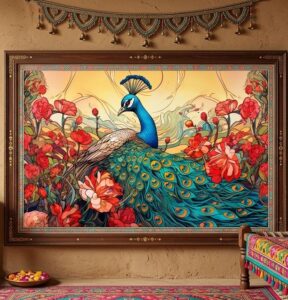
Madhubani art, originating from Bihar, is widely recognized for its intricate patterns and symbolic motifs. Traditionally, artists use natural pigments extracted from turmeric, indigo, flowers, and soot. The base surface is often handmade paper or mud walls coated with cow dung.
Because only organic materials are used, the process remains biodegradable and non-toxic. Therefore, Madhubani continues to be a strong example of sustainable artistic practice.
- Warli Art

Warli art, practiced in Maharashtra, reflects the simplicity of tribal life. It is created using a white pigment made from rice paste, applied to mud walls.
Since the materials are entirely natural and locally sourced, the environmental footprint is minimal.
- Pattachitra Art
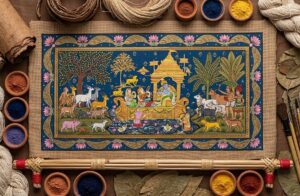
Pattachitra, from Odisha, involves detailed paintings on cloth that is treated with chalk and natural adhesives. The colours are derived from minerals, stones, and plant sources.
As a result, even highly detailed artworks are created without synthetic chemicals.
- Santhal Painting
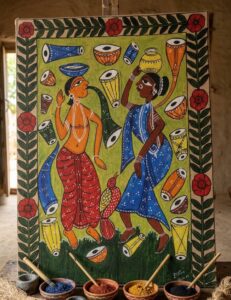
Santhal paintings, originating from the Santhal tribes of West Bengal, Bihar, Odisha, and Jharkhand, are known for their vibrant depiction of tribal life and folklore.
These paintings rely heavily on plant-based colours derived from natural sources such as leaves, flowers, and roots.
Because of this process, the paintings remain free from synthetic chemicals.
- Tanjore and Mysore Paintings
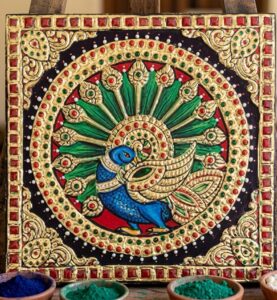
Tanjore paintings from Tamil Nadu, along with Mysore paintings, are known for their richness, detailed ornamentation, and vibrant colour schemes.
Traditionally, these paintings use natural dyes derived from vegetables and minerals. The base is typically a wooden plank covered with cloth, which is then coated with a paste made from limestone and natural adhesives.
Although these artworks are often associated with opulence, their foundation remains rooted in sustainable practices.
- Tala Pattachitra
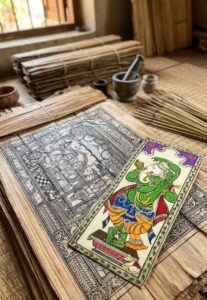
Tala Pattachitra is a unique variation of Pattachitra art that uses palm leaves as its canvas. The leaves are first dried, treated, and then stitched together to create a flexible and durable surface.
In addition, natural dyes made from flowers and lamp black are used for illustration. Because palm leaves are renewable and biodegradable, this art form stands out as a highly sustainable practice.
- Kalamkari Painting
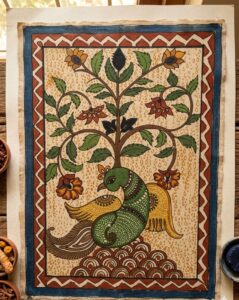
Kalamkari, originating from Andhra Pradesh and Telangana, is a detailed hand-painted or block-printed textile art form.
Artists use vegetable dyes extracted from sources such as pomegranate bark, iron filings, jaggery, and roots. The fabric, usually cotton or silk, is treated with natural mordants to ensure colour absorption.
As a result, Kalamkari stands as a powerful example of how complex artistic processes can remain environmentally responsible.
Modern Innovations and Eco-Friendly Materials in Indian Art
While traditional Indian art forms have always been rooted in sustainability, a significant shift has been observed in contemporary practices as well. Today, modern Indian artists are not only revisiting indigenous materials but are also experimenting with innovative, eco-friendly alternatives.
Recycled materials are used by contemporary Indian artists such as Nalini Malani and Anju Dodiya to create large-scale installations. These installations encourage sustainability while also increasing public awareness about a host of environmental issues.
Challenges and Solutions
Even though sustainability is gaining attention in the Indian art world, several challenges continue to exist.
One of the major challenges is the accessibility of sustainable materials. Another issue that has been observed is the lack of awareness among consumers.
Despite these challenges, several solutions are being explored to promote sustainability in Indian art.
Firstly, government support plays a crucial role. Initiatives introduced by organizations like the Ministry of Culture are helping promote environmentally responsible practices
In addition, integrating sustainability into art education is proving to be highly effective. When young artists are trained to work with eco-friendly materials from the beginning, sustainable practices become a natural part of their creative process.
Final Thoughts
In conclusion, the use of indigenous materials in modern Indian art practices represents a meaningful shift toward sustainability. Traditional art forms have already shown that creativity and environmental responsibility can go hand in hand.
Now, contemporary artists are building on this foundation by innovating with recycled and eco-friendly materials. Therefore, eco-friendly art is not just a trend but a necessary evolution.
Giftex: Modern and Contemporary Indian Art Auction
This April, Giftex presents its Modern Indian Art Auction, bringing together a curated collection of remarkable masterpieces. Featuring well-known works by celebrated artists, this auction is an opportunity not to be missed.


About Post Author